Salzburg

The most beautiful lakes in Austria

The 15 Most Beautiful Lakes in Austria for 2026 (with Insider Tips)

Austria actually has thousands of lakes, ranging from small standing waters and crystal-clear mountain water to warm swimming lakes. Lake Klopein (Klopeiner See) in southern Carinthia heats up to 28 degrees Celsius in summer, making it the warmest swimming lake in Europe.

In this article, we present the 15 best lakes in Austria (subjectively, of course), from famous highlights to hidden insider tips. We also provide a practical “Lakes in Austria Map” for better orientation. These beautiful lakes in Austria offer something for everyone, whether you want to swim, hike, or enjoy water sports.

Key Takeaways

With its lakes, Austria offers an incredible variety for every taste—from warm swimming lakes to crystal-clear mountain lakes.

• Lake Klopein is Europe’s warmest swimming lake at up to 29°C and offers drinking water quality
• Carinthia is perfect for road trips (or cycling trips) between several lakes in short distances
• The Salzkammergut combines UNESCO World Heritage with spectacular nature experiences
• Arriving early at popular destinations like Hallstatt helps avoid tourist crowds
• June to August are ideal for swimming; May and September are perfect for hiking

The best strategy is to choose a region and combine several lakes within it. With the right planning and early booking, you will experience unforgettable moments in Austria’s most beautiful natural paradises.

Achensee – The Tyrolean Sea
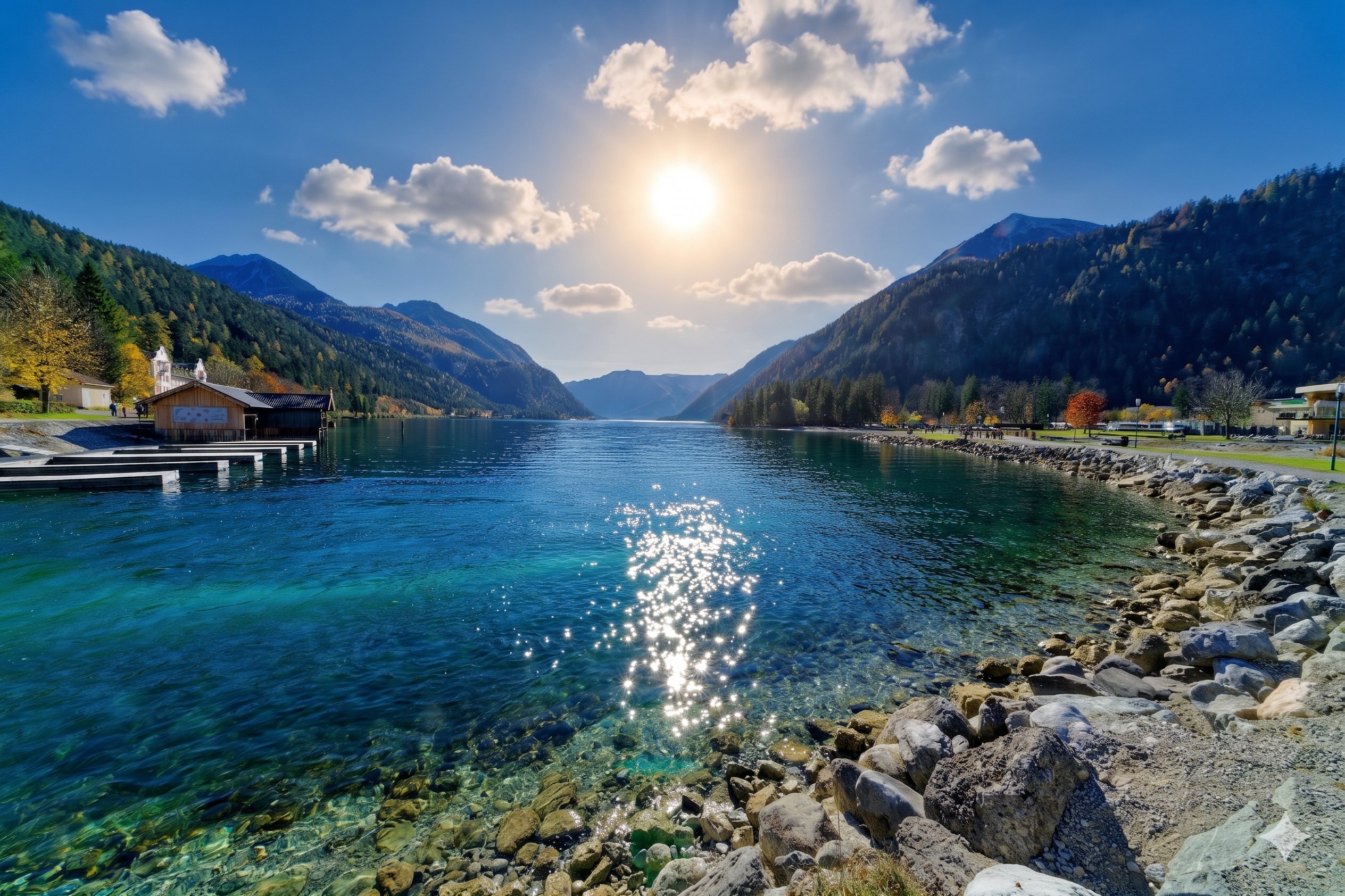
Achensee
Achensee, Holger Uwe Schmitt, CC BY-SA 4.0, via Wikimedia Commons (Image edited)

Location and Arrival at Achensee

Lake Achen (Achensee) is located at an altitude of 929 meters between the Karwendel Mountains and the Rofan Mountains in North Tyrol. At 9 kilometers long and up to 133 meters deep, it is Tyrol’s largest lake. Getting there is easy. Jenbach serves as the central transport hub and is only 25 minutes by bus from the lake. The Railjet from Vienna stops here up to eight times a day. As a guest of the holiday region, you travel completely free of charge by public bus from Jenbach station to Achensee. Your accommodation booking confirmation serves as your ticket.

Special Features of Achensee

The crystal-clear water reaches temperatures between 20 and 22 degrees in summer. The water quality is equivalent to drinking water, and visibility reaches up to 10 meters below the surface. Particularly fascinating: In winter, the water level drops by up to five meters(!). The Achensee power plant uses 38 million cubic meters of water as storage volume and generates 219 gigawatt-hours of electrical energy per year.

Activities at Achensee

Water sports are very popular here. Light winds in the morning and stronger winds in the afternoon create ideal conditions for sailing and surfing. Paragliding offers spectacular views of the turquoise-blue lake nestled between the mountains. Hikers can explore around 500 kilometers of marked trails in the Karwendel Nature Park and the Rofan Mountains. The Achensee shipping service connects all major towns on the lake in a hop-on/hop-off style.

Insider Tip for Achensee

The Dalfaz Alm at 1,693 meters offers homemade cakes and a fantastic view of the lake. The Dalfaz Waterfall plunges over 60 meters and is particularly impressive after the snow melts in early summer.

Attersee – Austria’s Largest Inland Lake
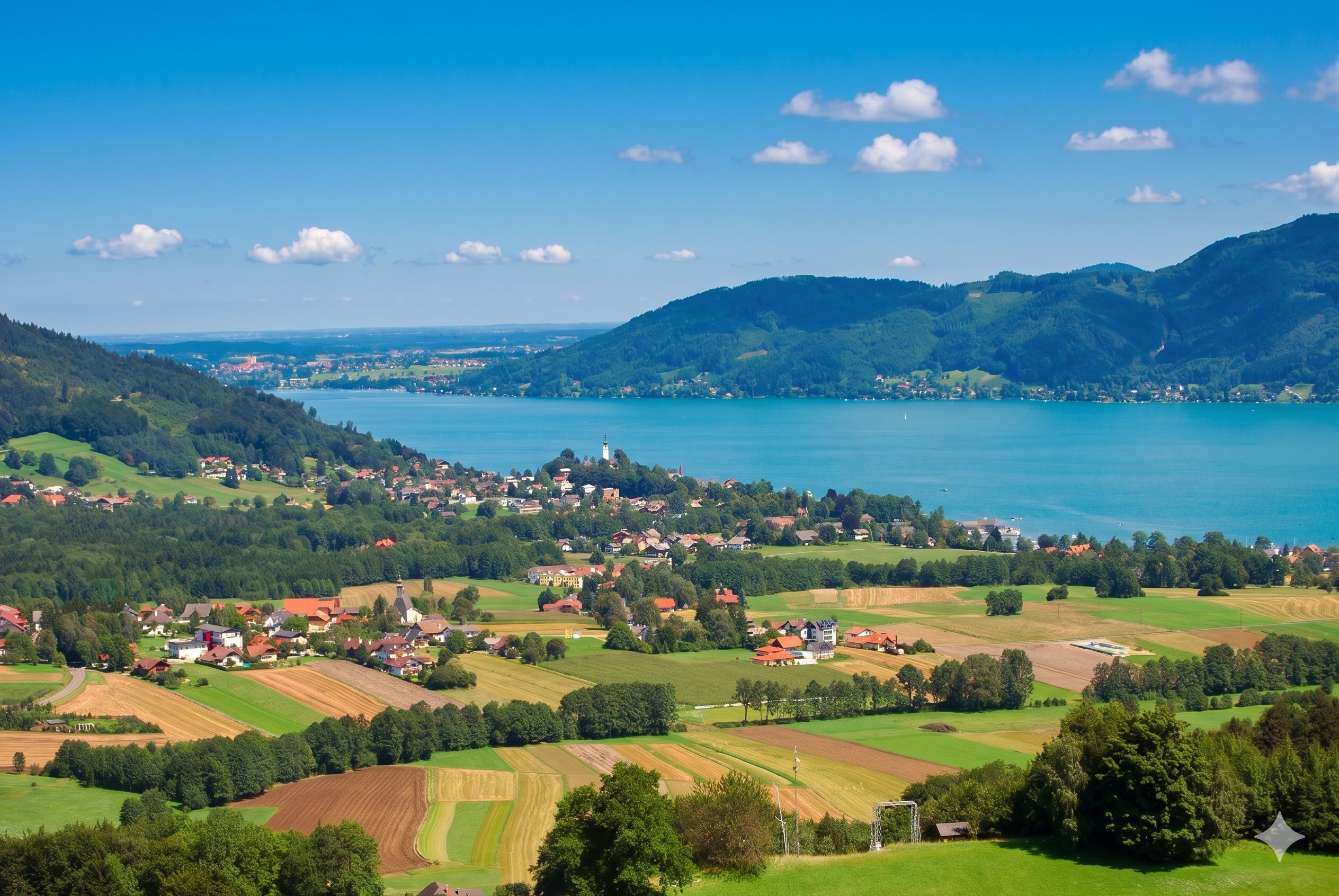
Attersee
Attersee, Rex250, CC BY-SA 3.0, via Wikimedia Commons (Image edited)

Location and Arrival at Attersee

With an area of 46.2 km², Lake Atter (Attersee) is the largest inland lake entirely located on Austrian territory. It stretches across the Upper Austrian Salzkammergut between the towns of Schörfling and Unterach at an altitude of 469 meters. The West Autobahn A1 runs directly along the lake with exits at Schörfling, Seewalchen, and St. Georgen.

Arrival by train works via Vöcklamarkt. From there, the narrow-gauge Attersee Railway runs to the town of Attersee. There is also a standard-gauge branch line from Vöcklabruck to Kammer am Attersee. The distance from Vienna is 250 kilometers, and only 55 kilometers from Salzburg.

Special Features of Attersee

The turquoise water has drinking water quality. Visibility is up to 25 meters, and it can be even better in the winter months. With a depth of 169 meters, Attersee is the second deepest lake in Austria after Traunsee.

The legendary “Rosenwind” makes it a paradise for sailors. During stable fair weather, a steady breeze is created by the mountain massif located to the south. The Union Yacht Club Attersee was founded back in 1886 and is one of the oldest sailing clubs in Austria.

Activities at Attersee

Stand-up paddling, sailing, windsurfing, and kitesurfing are among the most popular water sports. Several sailing schools offer courses and boat rentals for beginners. The clear water attracts divers, with the visibility and underwater cliffs on the eastern shore offering special nature experiences. For fishing, you need a valid fishing card, available at tourist offices or fishing shops.

Insider Tip for Attersee

The Alexenau swimming area between Weyregg and Steinbach shows the turquoise water at its best in the afternoon. The Huthausaufsatz natural bathing spot was recently expanded by the Federal Forests to 7,200 square meters.

Wörthersee – The Caribbean of the Alps
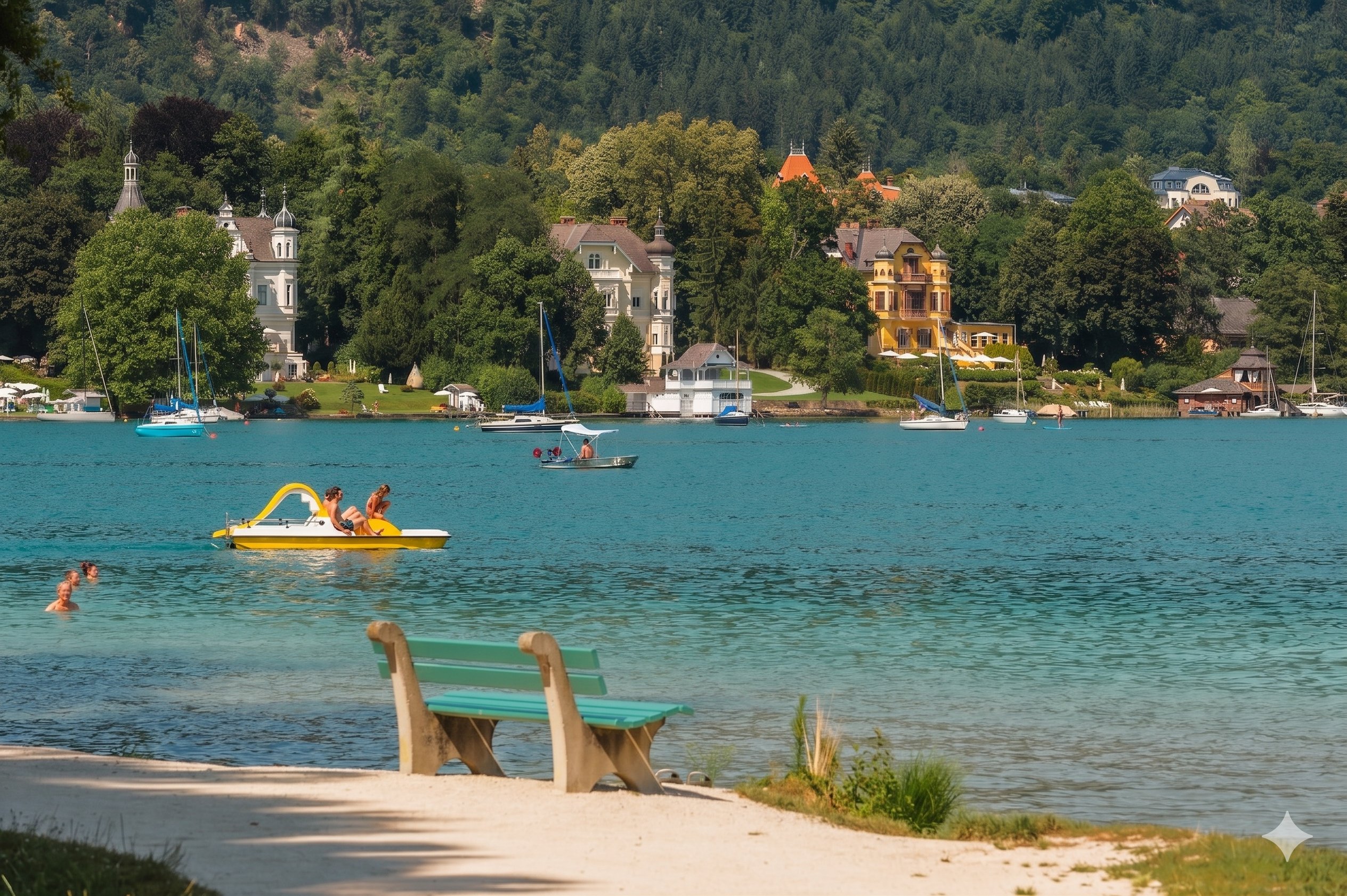
Pörtschach Wörther See
Pörtschach Wörther See, Johann Jaritz / CC BY-SA 4.0, CC BY-SA 4.0, via Wikimedia Commons, (Image edited)

Location and Arrival at Wörthersee

Carinthia’s largest lake stretches over 16 kilometers in length between Villach and Klagenfurt. Its area of 19.4 square kilometers is divided into three basins. Klagenfurt is only 4 kilometers to the east and is connected to the lake by the Lend Canal.
Arrival is easy via the A10 Tauern Autobahn and A2 South Autobahn. Starting March 2026, the WESTbahn will connect Vienna and Villach five times a day with a direct stop in Pörtschach; the travel time is only 3 hours and 23 minutes. Since the opening of the Koralm Railway, you can reach Wörthersee from Graz in just 42 minutes, with tickets starting at €8.99. Klagenfurt Airport is 20 kilometers away, or alternatively, Ljubljana is 87 kilometers away.

Special Features of Wörthersee

The turquoise-blue color is unmistakable. The water temperature reaches 22 to 27 degrees Celsius in summer, and the top layer of water down to eight meters heats up to over 25 degrees. Therefore, it is one of the warmest Alpine lakes. The Klagenfurt basin ensures an almost Mediterranean climate with 8 to 9 hours of sunshine daily in summer.

Activities at Wörthersee

The 40-kilometer bike path leads completely around the lake. Water sports are a must: sailing, windsurfing, water skiing, stand-up paddling, and parasailing. The Wörthersee fleet offers trips between Klagenfurt and Velden with the nostalgic ship Thalia or the electric-solar ship Maria Wörth. The Pyramidenkogel is the highest wooden observation tower in the world at 100 meters.

Insider Tip for Wörthersee

Krumpendorf on the north shore is more charming and less crowded than Velden or Pörtschach. The Parkbad stretches over 17,000 square meters and is the second-largest beach bath on Wörthersee. A floating library with over 1,500 books visits the various beach baths.

Wolfgangsee – Pearl of the Salzkammergut
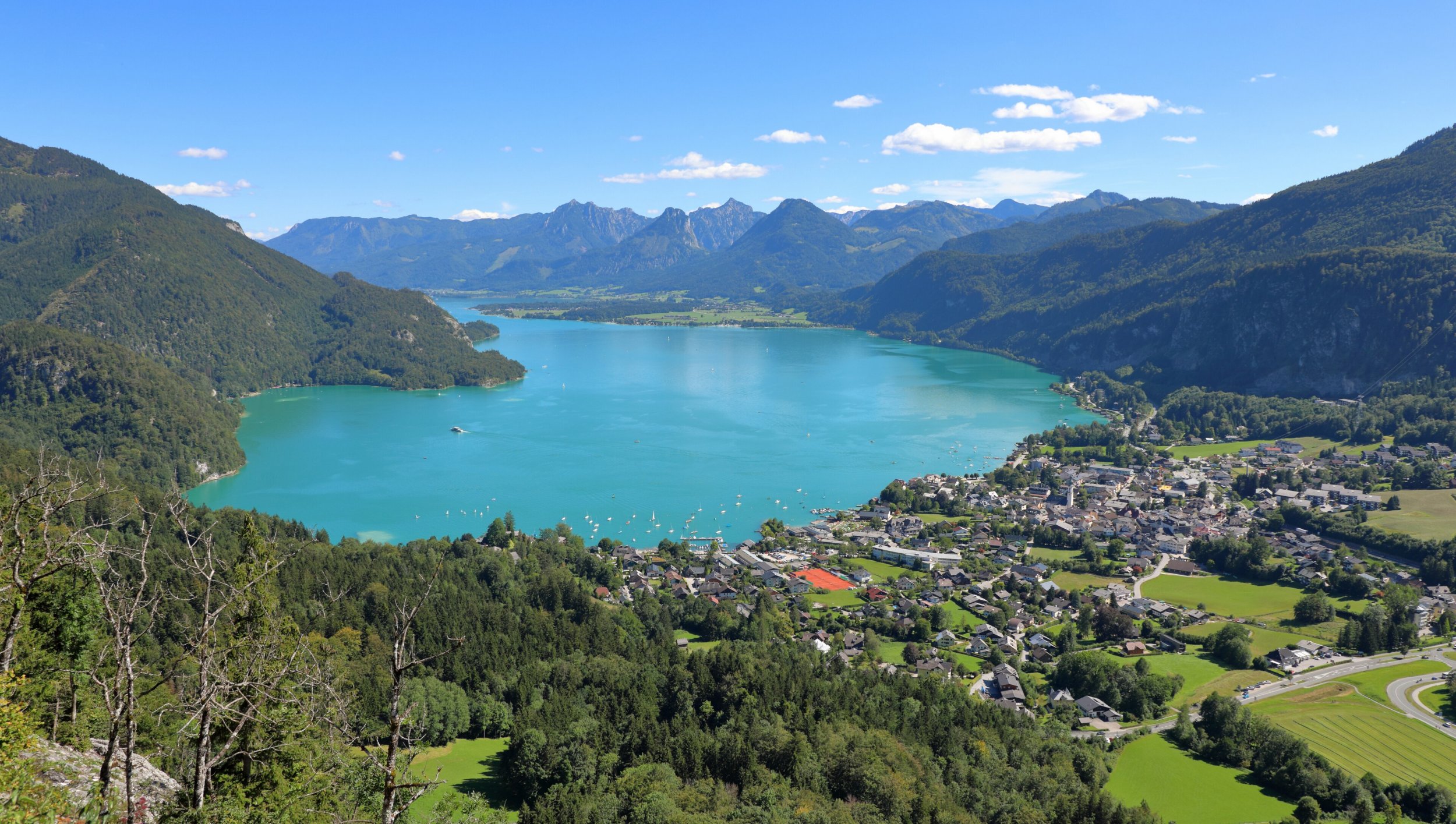
Wolfgangsee Nordwestansicht
Wolfgangsee Nordwestansicht, C.Stadler/Bwag, CC BY-SA 4.0, via Wikimedia Commons

Location and Arrival at Wolfgangsee

Three charming towns surround this lake: St. Wolfgang, St. Gilgen, and Strobl. Lake Wolfgang (Wolfgangsee) connects the federal states of Upper Austria and Salzburg. Nestled between the Schafberg in the west and the Zwölferhorn in the east, it lies in an idyllic alpine landscape.

By train, you travel via Salzburg Main Station or Bad Ischl Station. From both stations, bus line 150 takes you directly to the lake. You can reach St. Wolfgang with bus line 546 from Strobl bus station. By car, take the A1 exit Regau if coming from Vienna or Linz, or the exit Thalgau or Mondsee from Salzburg.

Special Features of Wolfgangsee

With its crystal-clear, turquoise water, Wolfgangsee is one of the cleanest lakes in Europe. Its original name was Abersee, documented as early as 800 AD. 500 years later, it was named after Saint Wolfgang, who made the town an important pilgrimage site of the Middle Ages. St. Wolfgang, along with Rome, Santiago, and Aachen, was considered the most significant pilgrimage center in the Christian West.

Activities at Wolfgangsee

The Schafberg Railway was put into operation in 1893 and is the steepest cog railway in Austria. The ride takes just over half an hour and covers 1,190 meters in elevation over 5.85 kilometers. From the summit of the 1,783-meter-high Schafberg, you can see seven lakes.

Wolfgangsee Shipping offers trips on the historic paddle steamer Kaiser Franz Josef I, which has been chugging across the lake since 1873. You can also enjoy sailing, surfing, diving, SUP, or water skiing.

Insider Tip for Wolfgangsee

The Wasswiese natural beach in Strobl offers a sunbathing lawn, jetty, and boat rental. The summer toboggan run in Gschwendt near Strobl has two tracks, each 1,300 meters long. The Lake Distillery in the old St. Wolfgang monastery cellar produces regional gin, with a specific variety dedicated to each Salzkammergut region.

Hallstätter See – UNESCO World Heritage Setting
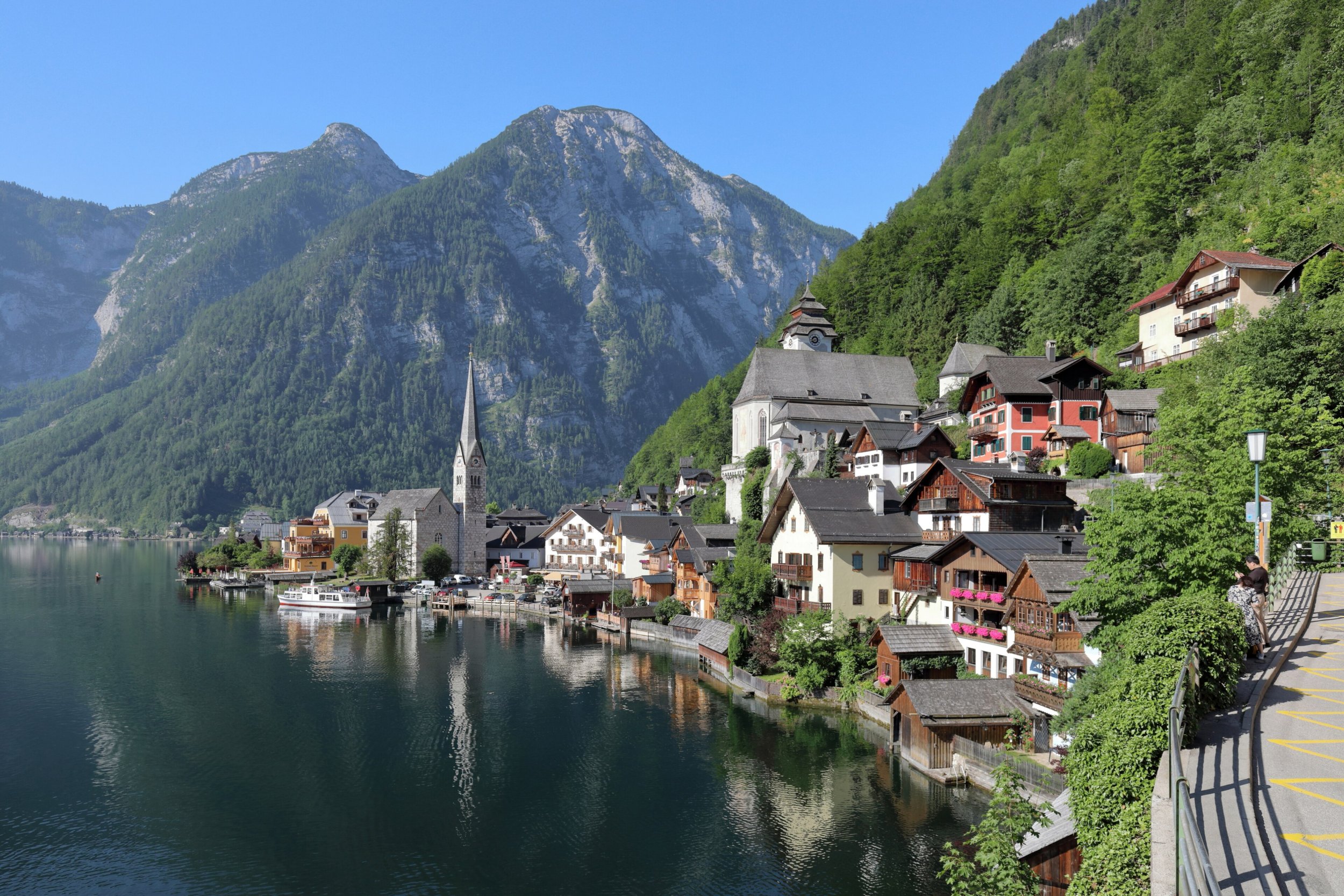
Hallstatt Nordansicht
Hallstatt Nordansicht, C.Stadler/Bwag, CC BY-SA 4.0, via Wikimedia Commons

Location and Arrival at Hallstätter See

Since 1997, the Hallstatt-Dachstein/Salzkammergut region has been a UNESCO World Heritage site. Lake Hallstatt (Hallstätter See) lies at 508 meters altitude at the northern foot of the Dachstein massif. At 7.5 kilometers long and 1.4 kilometers wide, it stretches like a fjord between steep mountain walls. Its area is 8.55 square kilometers with a maximum depth of 125 meters.

From the north, you reach the lake via the A1 exit Regau, then through Gmunden and Bad Ischl. The travel time from Gmunden is about one hour. From Salzburg, it’s a 45-minute drive via the A10 exit Golling and the B166. A vignette is required for all motorways, available at petrol stations.

Hallstatt station is located on the eastern shore opposite the town center. The ferry Stefanie takes you from the station to the center year-round. You can easily take bicycles with you.

Special Features of Hallstätter See

UNESCO recognized the region as an exceptional natural landscape with early and continuous human activity. The lake connects the four towns of Hallstatt, Obertraun, Bad Goisern, and Gosau. The traditional “Zillen”—flat wooden boats similar to Venetian gondolas—are part of the intangible UNESCO cultural heritage. As early as the 13th century, these single-oar boats transported salt across the lake.

Activities at Hallstätter See

The shipping service offers two circular tours: the south route connects Hallstatt with Obertraun, and the north route leads to Untersee and Steeg. Boat trips with historic “Zillen” cost between 10 and 15 euros. Rowing, pedal, and electric boats are available starting at 10 euros for half an hour.

The 11-kilometer Ostuferweg (East Shore Path) on the sunny side of the lake is one of the most beautiful hiking trails in the Salzkammergut. Along the way, the Gasthaus Seeraunzn invites you for a break.

Insider Tip for Hallstätter See

Visit Hallstatt early in the morning at sunrise, when the town is in magical silence. The company Navia offers romantic “Zillen” trips at sunset or relaxed early morning trips on the water.

Weißensee – Nature Paradise in Carinthia
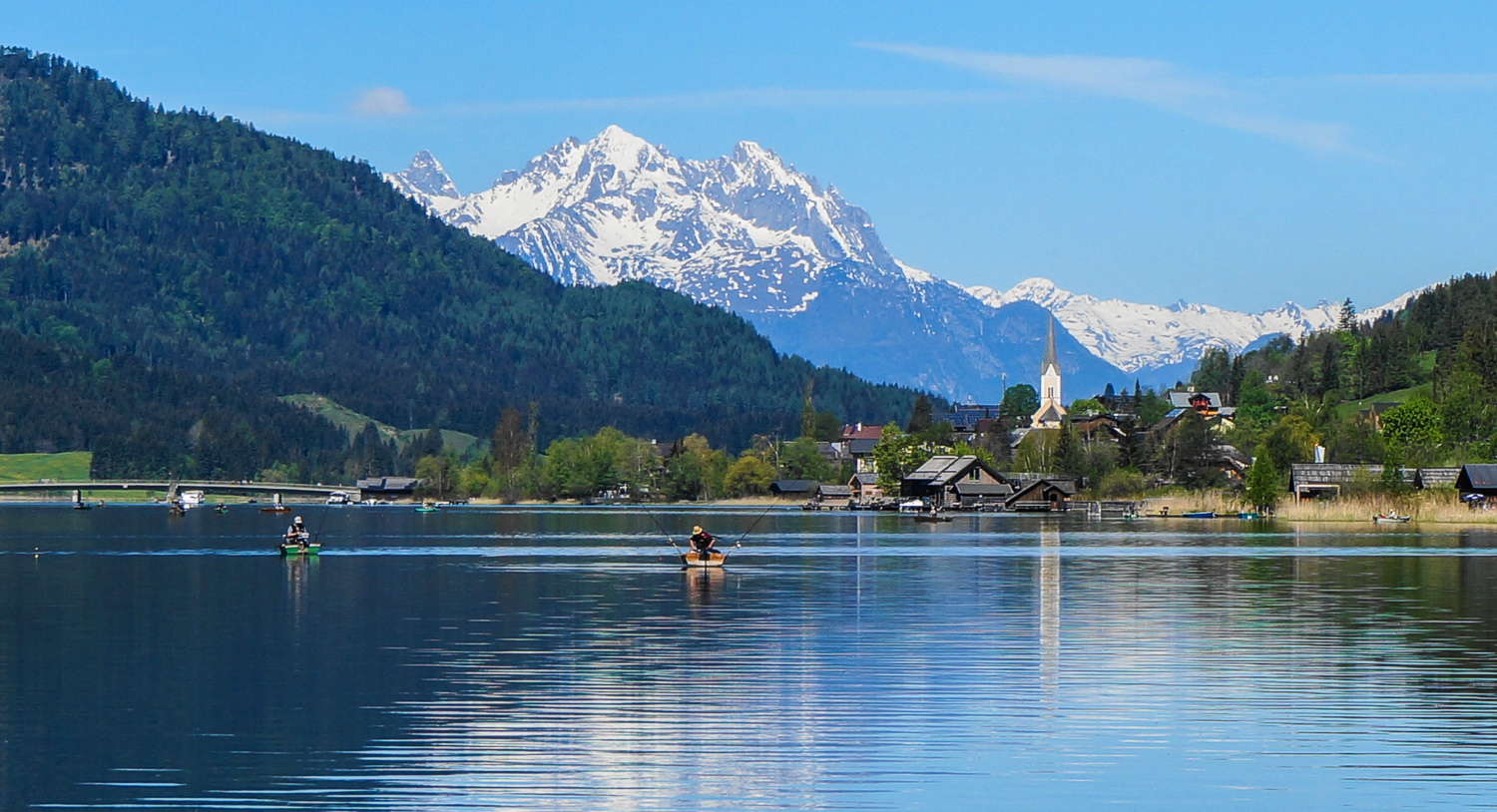
Weißensee
Weißensee, Naturpuur, CC BY 4.0, via Wikimedia Commons

Location and Arrival at Weißensee

At 930 meters altitude, Carinthia’s highest swimming lake is nestled in the Gailtal Alps. The fjord-like lake stretches over 11.6 kilometers and reaches a depth of 99 meters at its deepest point. A 76-square-kilometer area around Lake Weissen (Weißensee) is under nature and landscape protection.

The journey leads through Greifenburg. From the north, take the Tauern Autobahn A10 to the Spittal interchange, then continue via Greifenburg to Weißensee. From the east, drive via the South Autobahn A2 to Villach, or alternatively, use the Hermagor/Gailtal exit. The nearest train station is in Greifenburg, from where a station shuttle takes you directly to your accommodation. Klagenfurt Airport is 120 kilometers away.

Special Features of Weißensee

The water is of drinking quality, making Weißensee Europe’s most natural alpine lake. Visibility reaches up to 6 meters. Combustion engines are permitted only for public shipping, water police, and agriculture. This results in exceptional peace and quiet on the water.

The western part shimmer in rich emerald green, while the eastern part glows in various shades of turquoise. The name comes from white limestone deposits on the shore, washed in from the surrounding mountains. In summer, the water warms up to 24 degrees.

Activities at Weißensee

The Weißensee shipping service operates from early May to late October and connects eight stations. In winter, the lake freezes over completely, forming Europe’s largest prepared natural ice surface with 6.5 square kilometers. Around 200 kilometers of hiking trails lead through the nature park, and 100 kilometers of mountain bike trails offer various levels of difficulty.

Insider Tip for Weißensee

The Kohlröslhütte at 1,540 meters can only be reached on foot in about 1.5 hours from the mountain station. The shore hiking trail starts at the Dolomitenblick and leads through completely undeveloped areas along the turquoise-blue shore.

Millstätter See – The Enchanting One
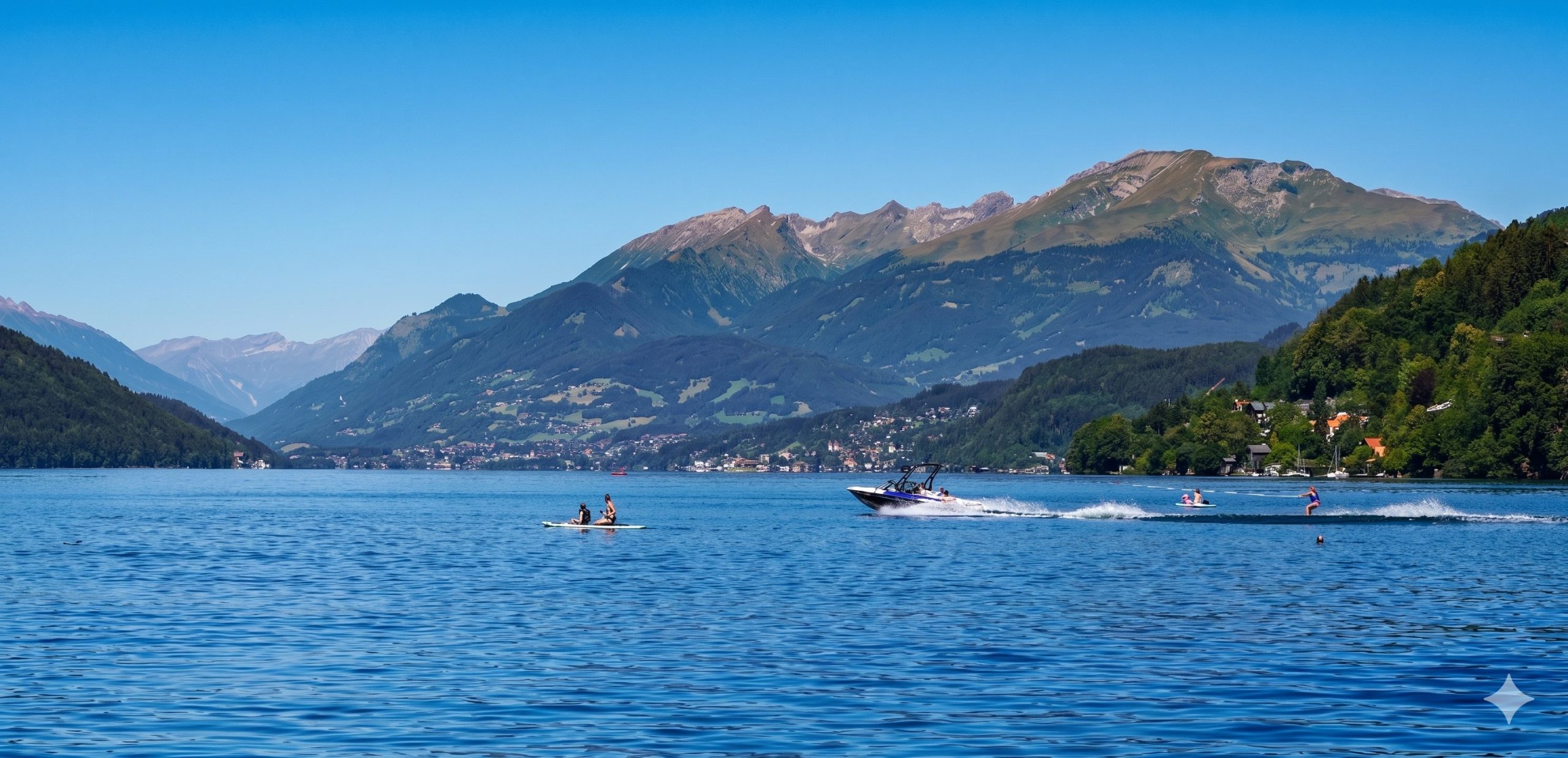
Ostufer Millstätter See
Ostufer Millstätter See, Naturpuur, CC BY-SA 4.0, via Wikimedia Commons, (Image edited)

Location and Arrival at Millstätter See

North of the Drau Valley and surrounded by mountains over 2,000 meters high, this enchanting lake lies at 588 meters altitude. At 12 kilometers long and up to 1.8 kilometers wide, it is Carinthia’s second largest lake after Wörthersee. The largest towns—Seeboden, Millstatt, and Döbriach—are spread along the north shore.

From the north, take the Tauern Autobahn A10 from Munich via Salzburg towards Spittal an der Drau until the Millstätter See exit. From the east, the South Autobahn A2 leads from Vienna and Graz via Klagenfurt and Villach. From Italy, you reach the lake via the A2 from Udine. The federal railway’s Tauern motorail offers a traffic-free alternative through the Tauern Tunnel between Böckstein and Mallnitz.

Special Features of Millstätter See

With a depth of 141 meters and a water volume of 1,204.5 million cubic meters, it is Carinthia’s most water-rich lake. The water is of drinking quality. The large amount of water and few inflows/outflows ensure that the lake warms up to 26 degrees in summer, with peak values even reaching 28 degrees.

Activities at Millstätter See

Water sports are a top priority: sailing, surfing, rowing, swimming, diving, water skiing, and stand-up paddling. The 28-kilometer bike path leads directly along the shore. Hikers can explore 14 tours with lake views in the certified hiking villages of Millstatt, Seeboden, and Döbriach. The shipping service connects all major stations around the lake.

Insider Tip for Millstätter See

The viewpoint in Gschriet near Ferndorf offers a magnificent panoramic view over the entire lake and the mountains. Villa Verdin in Millstatt serves organic coffee in bean bags directly by the lake. The Kleinsasserhof near Spittal combines food, drink, and art.

Zeller See – Salzburg’s Jewel
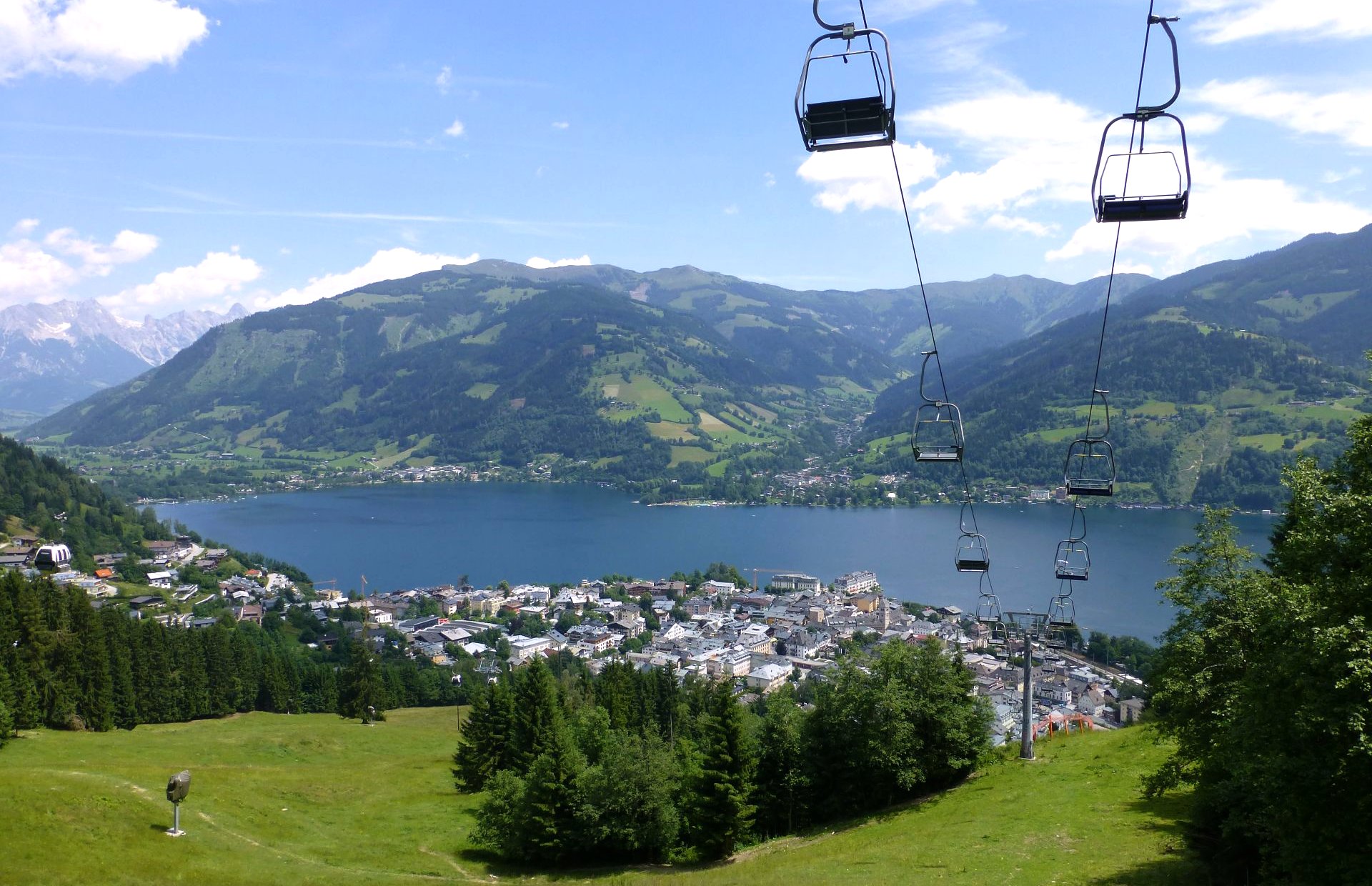
Zeller See, Ebenbergbahn
Zeller See, Benutzer:Wald1siedel, CC BY-SA 3.0 AT, via Wikimedia Commons

Location and Arrival at Zeller See

Guarded by majestic peaks, Zell am See is located directly on the shore of Lake Zell (Zeller See). The train takes you directly to the center of Zell am See. On foot, you are immediately in the thick of things.

From Vienna, take the B 227, A1 via St. Pölten and Salzburg, then the A8 and B 312 via the Steinpass to Zell am See. From Munich, drive via the A8, Traunstein, and Siegsdorf. Salzburg Airport is only 80 kilometers away. You can reach us directly by shuttle or taxi.

As an overnight guest, you receive the Guest Mobility Ticket. This allows you to use all public transport in the entire province of Salzburg free of charge.

Special Features of Zeller See

At 3.8 kilometers long and 1.5 kilometers wide, Zeller See is one of the most beautiful lakes in Austria. Its area of 455 hectares makes it the fourth largest lake in the province of Salzburg. The crystal-clear water is of drinking quality and reaches a pleasant 23 degrees in summer. On hot days, it even climbs to 24 degrees.

The depth of up to 70 meters provides refreshing cooling. The clear visibility and abundance of fish make the lake an Eldorado for divers and anglers.

Activities at Zeller See

Three beach baths welcome you: Zell am See, Thumersbach, and Schüttdorf. All of them feature diving towers, slides, water trampolines, and children’s playgrounds. In addition, you will find free bathing areas at the north shore (Wieshof) and the south shore (Erlberg).

Four ships are available for panoramic tours, including the nostalgic ship Libelle. Water sports such as stand-up paddling, surfing, sailing, and water skiing are available here.

Insider Tip for Zeller See

The Plettsaukopf reservoir reflects the mighty Kitzsteinhorn and the surrounding mountains in its crystal-clear water. From the Schmittenhöhe at nearly 2,000 meters altitude, you can see more than 30 peaks over three thousand meters with a 360° panorama.

Mondsee – Film Set and Swimming Paradise
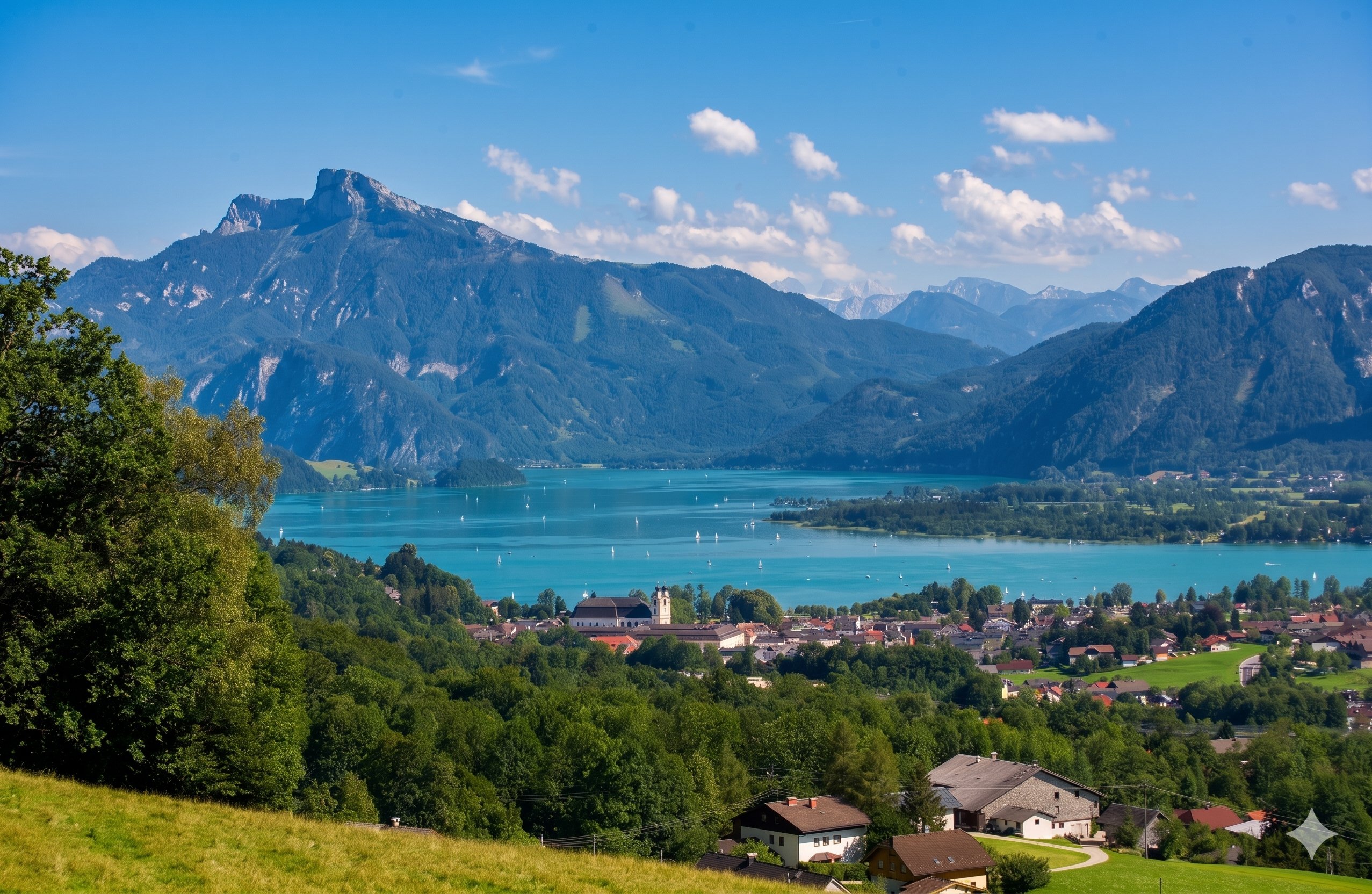
Mondsee
Mondsee, TVB Mondsee – Irrsee, CC BY 2.0, via Wikimedia Commons, (Image edited)

Location and Arrival at Mondsee

The famous basilica from the movie The Sound of Music made this lake world-famous. Lake Mond (Mondsee) is located in the Salzburg Salzkammergut, only an hour by bus from the City of Mozart. Bus line 140 takes you directly here from Salzburg Main Station; the journey takes about an hour. By car, take the A1 West Autobahn and the Mondsee exit.

Special Features of Mondsee

The wedding scene in the Hollywood film was shot in the imposing Mondsee Basilica. More than 50 years after the film’s premiere, thousands of people still visit the famous wedding church every year. As with most lakes in Austria, the water is of drinking quality and warms up to 27 degrees in summer, making it one of the warmest swimming lakes in Austria.

Activities at Mondsee

The Alpine Beach Bath features a diving tower, sandy beach, water slides, and beach volleyball courts. Three public bathing areas are available: Schwarzindien, Loibichl, and Plomberg. On the lake, you can go sailing, kayaking, water skiing, and diving. The shipping service offers circular tours with magnificent views of the surrounding mountains.

Insider Tip for Mondsee

The neighboring Irrsee is completely under nature protection and offers rowing boat tours with wooden boats.

Ossiacher See in Carinthia
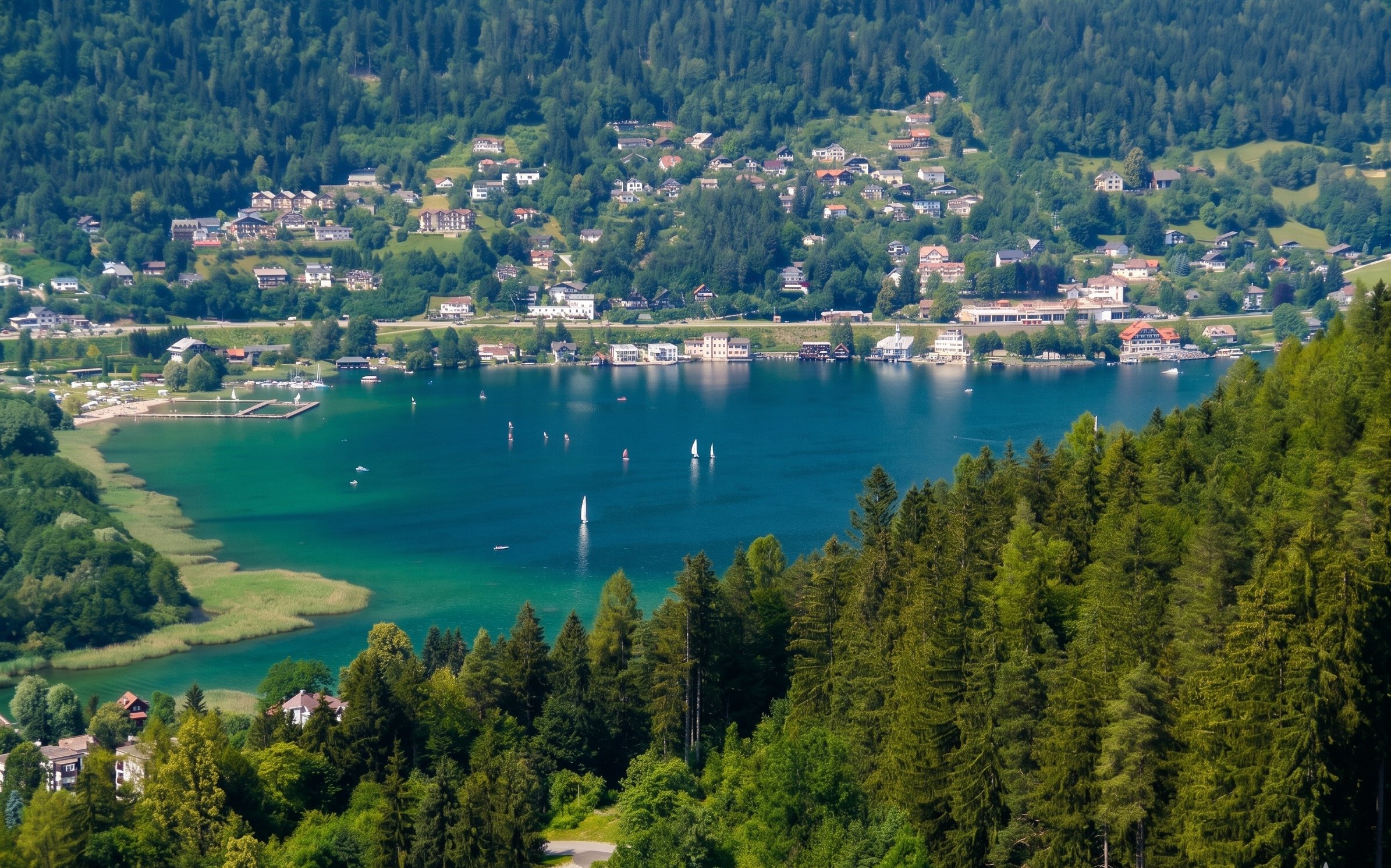
Ossiacher See
Ossiacher See, Zairon, CC BY-SA 3.0, via Wikimedia Commons, (Image edited)

Location and Arrival at Ossiacher See

As Carinthia’s third largest lake, Lake Ossiach (Ossiacher See) lies northeast of Villach. Its area is 10.79 km², with a length of 11 kilometers and a shore length of 25 kilometers. From the Villach motorway junction, take the Villach-Ossiacher See exit. The Tauern Autobahn A10 leads directly to the region. Villach Main Station is the nearest train station, from where buses and trains run to the north shore.

Special Features of Ossiacher See

The water reaches up to 27 degrees in summer and is of drinking quality. The lake consists of two basins: the eastern one with a depth of 11 meters and the western one with a depth of 52 meters. Visibility for diving is 5 to 8 meters, and the lake is divable year-round. Night dives are permitted without a permit.

Activities at Ossiacher See

Diving is the focus here. The “Tauchschule Kärnten Pazifik” in Sattendorf offers courses for beginners and professionals. From the Gerlitzenbad, you can reach a pile dwelling and sunken Christmas trees as dive spots. You can also enjoy sailing, surfing, kayaking, and SUP. The 28.6-kilometer bike path with only 85 meters of elevation gain is perfect for families.

Insider Tip for Ossiacher See

Kathrin’s Buschenschenke is hidden high above the lake. With a cold platter (Brettljause) and homemade juices, you enjoy the best far-reaching view over Lake Ossiach.

Faaker See – The Turquoise One
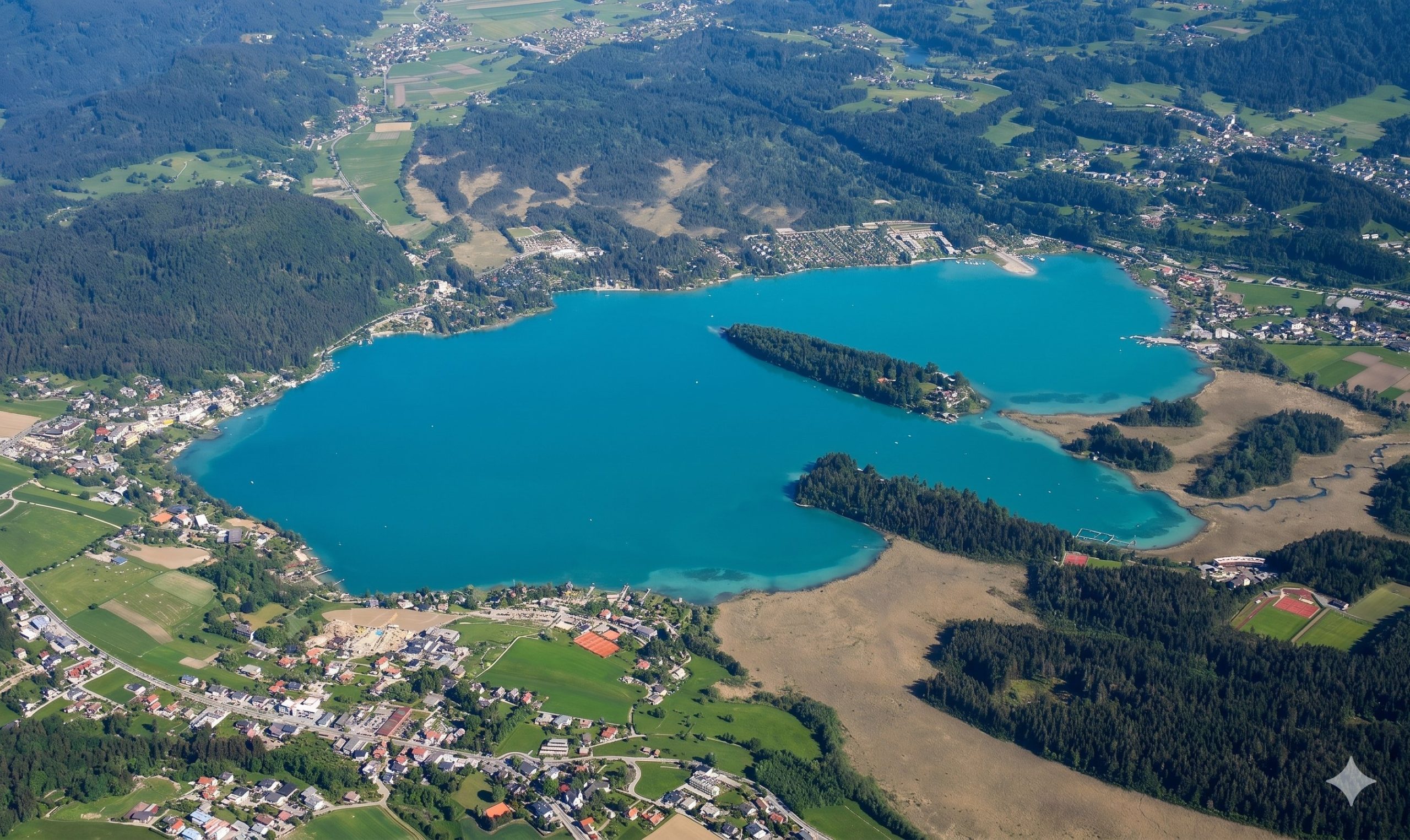
Faaker See
Faaker See, Carsten Steger, CC BY-SA 4.0, via Wikimedia Commons, (Image slightly edited)

Location and Arrival at Faaker See

In the border triangle between Austria, Italy, and Slovenia, the country’s southernmost swimming lake shimmers turquoise blue below the striking Mittagskogel mountain. You reach the Villach region via the A10 Tauern Autobahn or A11; both directions lead to the St. Niklas exit. Villach Main Station is only 7 kilometers away, and Klagenfurt Airport is about 40 kilometers.

Special Features of Faaker See

Fine limestone particles from the Worounitza stream give the water its unique turquoise-blue color. The purity often exceeds drinking water standards and it warms up to 27 degrees. With an average of 300 days of sunshine a year, the region is considered a perfect place for sunseekers. The lake carries the title of “Cleanest swimming lake in the Alpine region.”

Activities at Faaker See

Private motorboats are prohibited, making the lake particularly suitable for gentle water sports such as SUP, kayaking, sailing, and swimming. The Kanzianiberg is one of Carinthia’s largest climbing areas. Families can explore the “Fuchsfährte” and “Woroun auf der Spur” adventure trails in Drobollach. The Lake.bike trail center at the Baumgartnerhof offers mountain bike tracks.

Insider Tip for Faaker See

The 1.5-kilometer-long reed meander in the west was named Carinthia’s most beautiful spot in 2019. The Panorama Beach lido in Drobollach is free of charge and offers a water slide and spacious sunbathing areas.

Klopeiner See – Europe’s Warmest Swimming Lake
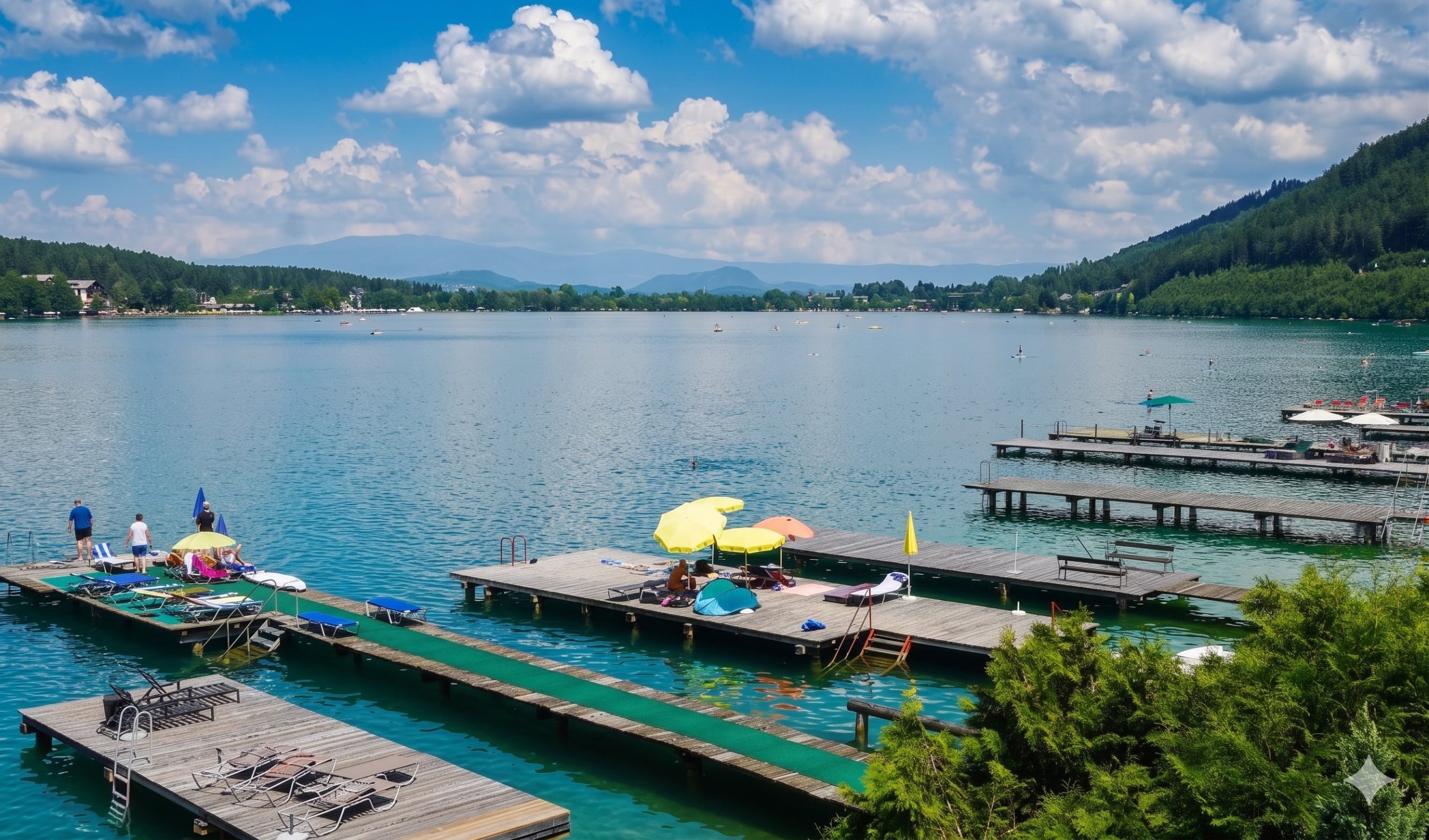
Klopeiner See
Klopeiner See, Naturpuur, CC BY-SA 4.0, via Wikimedia Commons, (Image edited)

Location and Arrival at Klopeiner See

In Austria’s southernmost holiday region, southwest of Völkermarkt, one of the warmest swimming lakes in Europe awaits you. The region is home to a total of 7 swimming lakes. Lake Klopein (Klopeiner See) is only 20 kilometers from Klagenfurt Main Station.

Arrival by car is via the A2 with exits at Grafenstein, Völkermarkt West, Völkermarkt Ost, or Griffen. By ÖBB or Westbahn, you reach Kühnsdorf-Klopeiner See station in about 3 hours from Vienna and 33 minutes from Graz. The station shuttle takes you directly to your accommodation. Regional buses run to all communities, and the “Postbus Shuttle 4-Seen” operates between Klopeiner See, Turnersee, Gösselsdorfer See, and Kleinsee. As a guest, you receive the Aktiv Card for free S-Bahn travel throughout Carinthia.

Special Features of Klopeiner See

The water reaches up to 29°C in summer, making the lake the warmest swimming lake in Europe. The drinking water quality is exceptional. Klopeiner See is the only lake in Carinthia where the entire shore is publicly accessible. The continuous lake promenade extends over 5.3 kilometers and is unique in Austria. Motorboats are generally not allowed, except for water rescue.

Activities at Klopeiner See

The circular path around the lake takes about 1.5 hours and is perfect for a walk. Stand-up paddling, diving, surfing, canoeing, and pedal boating are among the most popular water sports. The Krainz beach bath on the east shore offers shallow, calm water for families. In total, 12 public bathing spots are available. The “Walderlebniswelt” in St. Kanzian covers 20,000 m² with a fox burrow, giant labyrinth, and slides. The Family Lake Festival takes place from May 23 to May 25, 2026.

Insider Tip for Klopeiner See

The nearby Turnersee is located in the middle of a nature reserve and is significantly quieter. The Gösselsdorfer See offers natural swimming experiences away from the main crowds. The Acoustic Lakeside Festival at Sonnegger See attracts over 3,000 visitors annually.

Traunsee – Austria’s Deepest Lake
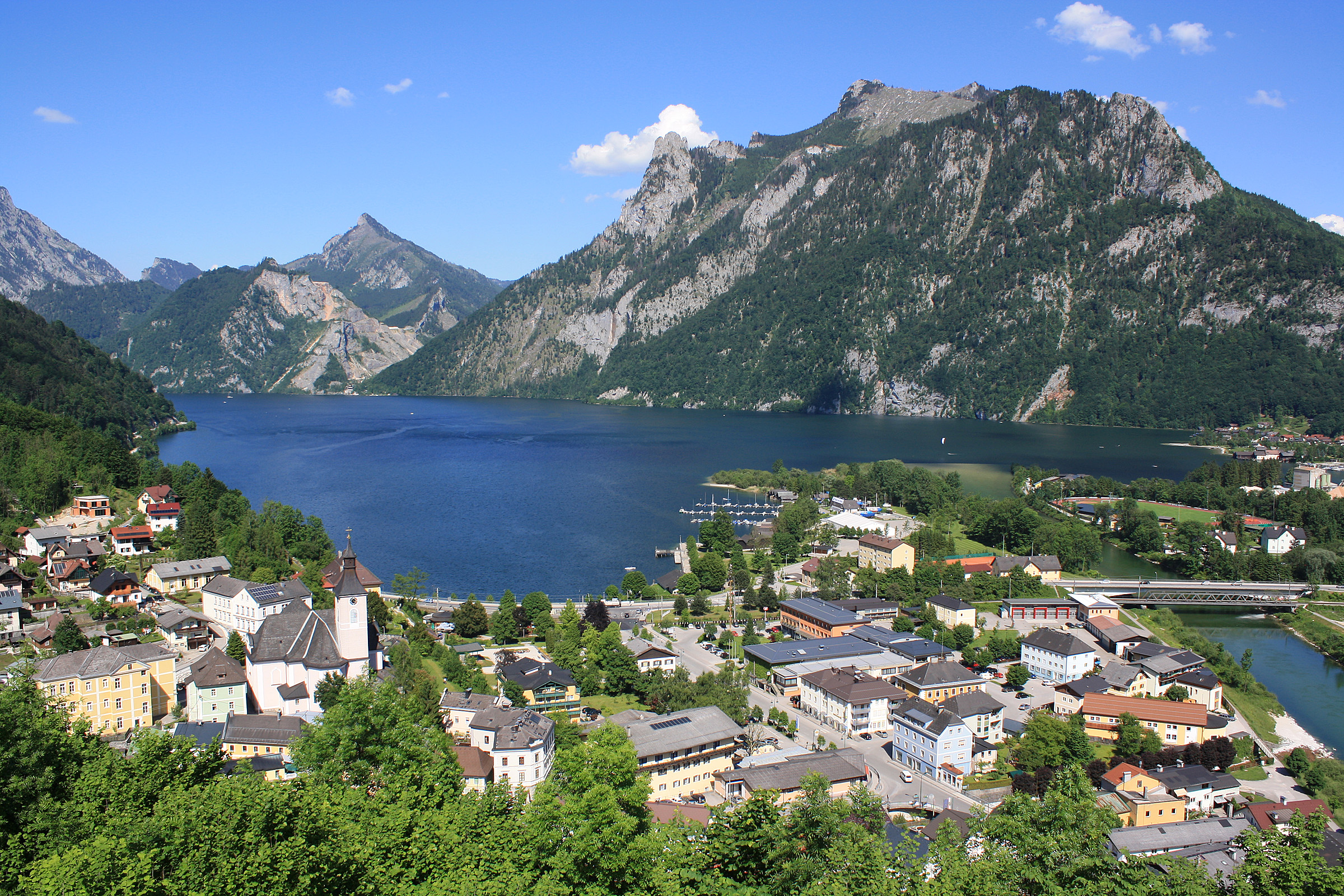
Ebensee am Traunsee
Ebensee am Traunsee, Tourismusbüro Ebensee, CC BY-SA 3.0, via Wikimedia Commons

Location and Arrival at Traunsee

In the Upper Austrian Salzkammergut, Lake Traun (Traunsee) lies at 422 meters altitude on the northern edge of the Limestone Alps. The Traun river flows through it from Ebensee in the south to Gmunden in the north. The Salzkammergut highway runs directly along the west shore. The Salzkammergut railway runs largely parallel to it. From Gmunden, the Traunsteinstraße runs about 5 kilometers along the east shore.

Special Features of Traunsee

At 191 meters, it is the deepest lake in Austria. Its area is 24.35 km², and its water volume is 2.302 km³. The water shows a rich blue-green tone and has near drinking quality. Visibility reaches up to 10 meters below the surface. Schloss Ort, located on a small island, is one of the oldest buildings in the Salzkammergut.

Activities at Traunsee

No other lake in Austria offers such a wide range of water sports. Sailing, diving, water skiing, wakeboarding, surfing, and stand-up paddling are all possible. Thanks to challenging winds, it is considered a sailing paradise. The Traunstein mountain at 1,691 meters is suitable for demanding hikes.

Insider Tip for Traunsee

The Karbach peninsula in the south is a hidden paradise for quiet swimming days.

Grüner See – The Emerald Green Natural Wonder
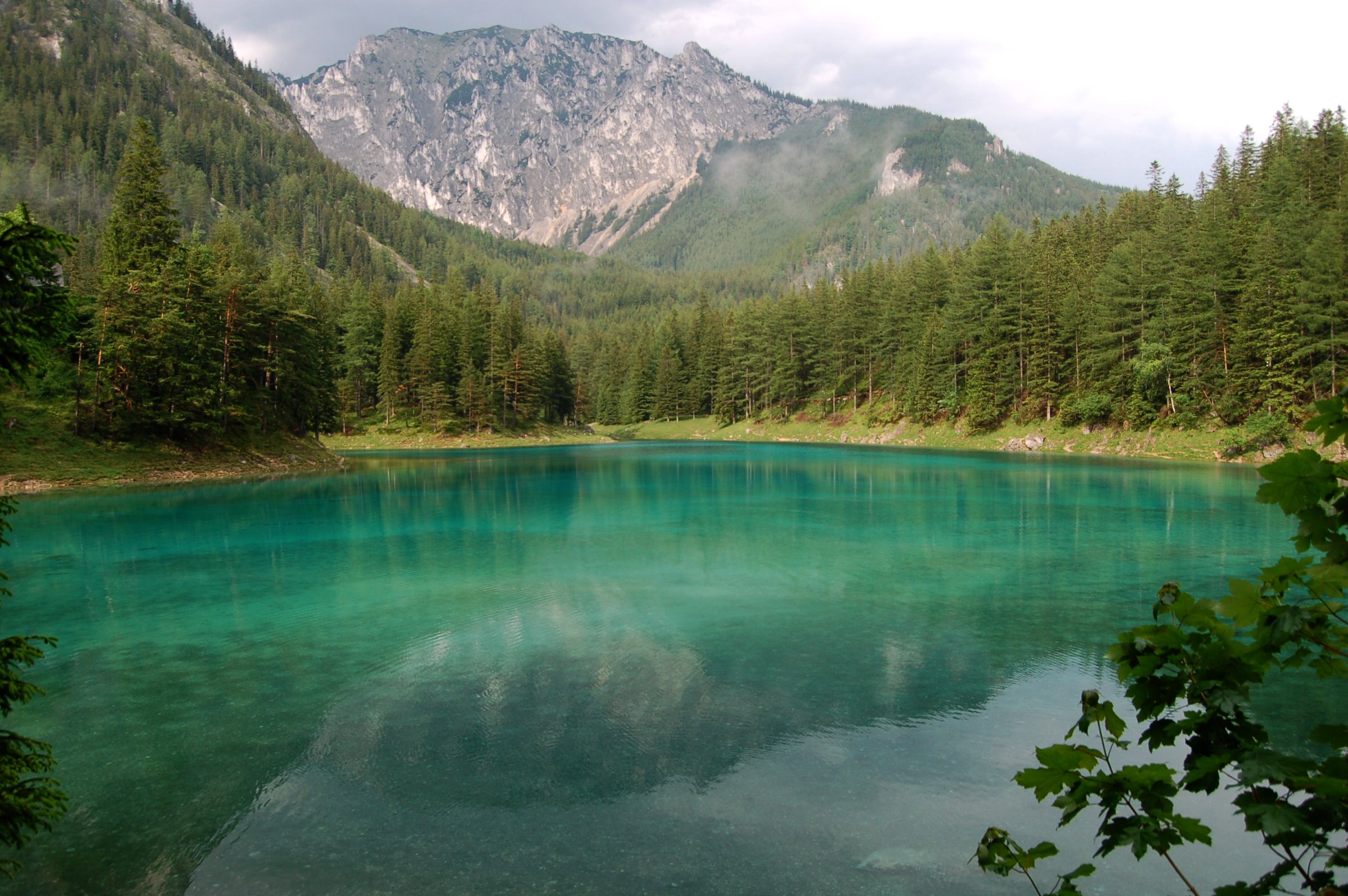
Grüner See
Grüner See, Herzi Pinki, CC BY-SA 3.0, via Wikimedia Commons

A lake that appears in spring and disappears in winter—Green Lake (Grüner See) is one of the most fascinating natural wonders among the beautiful lakes in Austria.

Location and Arrival at Grüner See

This karst lake is located in Tragöß-Sankt Katharein in Styria at 768 meters altitude. From Bruck an der Mur, bus line 175 takes you directly to the Grüner See car park. The parking fee is €6 for 24 hours. From the car park, you walk about 20 to 30 minutes to the lake.

Special Features of Grüner See

With the snow melt, the basin fills in spring with crystal-clear meltwater. The lake reaches its maximum depth in May and June with up to 10 meters. The emerald green color is caused by pure water and finely ground limestone. Visibility is up to 50 meters. In 2014, it was voted the most beautiful place in Austria. However, the lake dried up completely in April 2025 for the first time in 60 years.

Activities at Grüner See

The circular path around the lake takes about an hour. Diving and swimming have been prohibited since 2016 to protect the water quality.

Insider Tip for Grüner See

The Kreuzteich pond is only one kilometer away and reflects the Pribitz and Meßnerin mountains in its clear water.

Neusiedler See – Steppe Lake in Burgenland
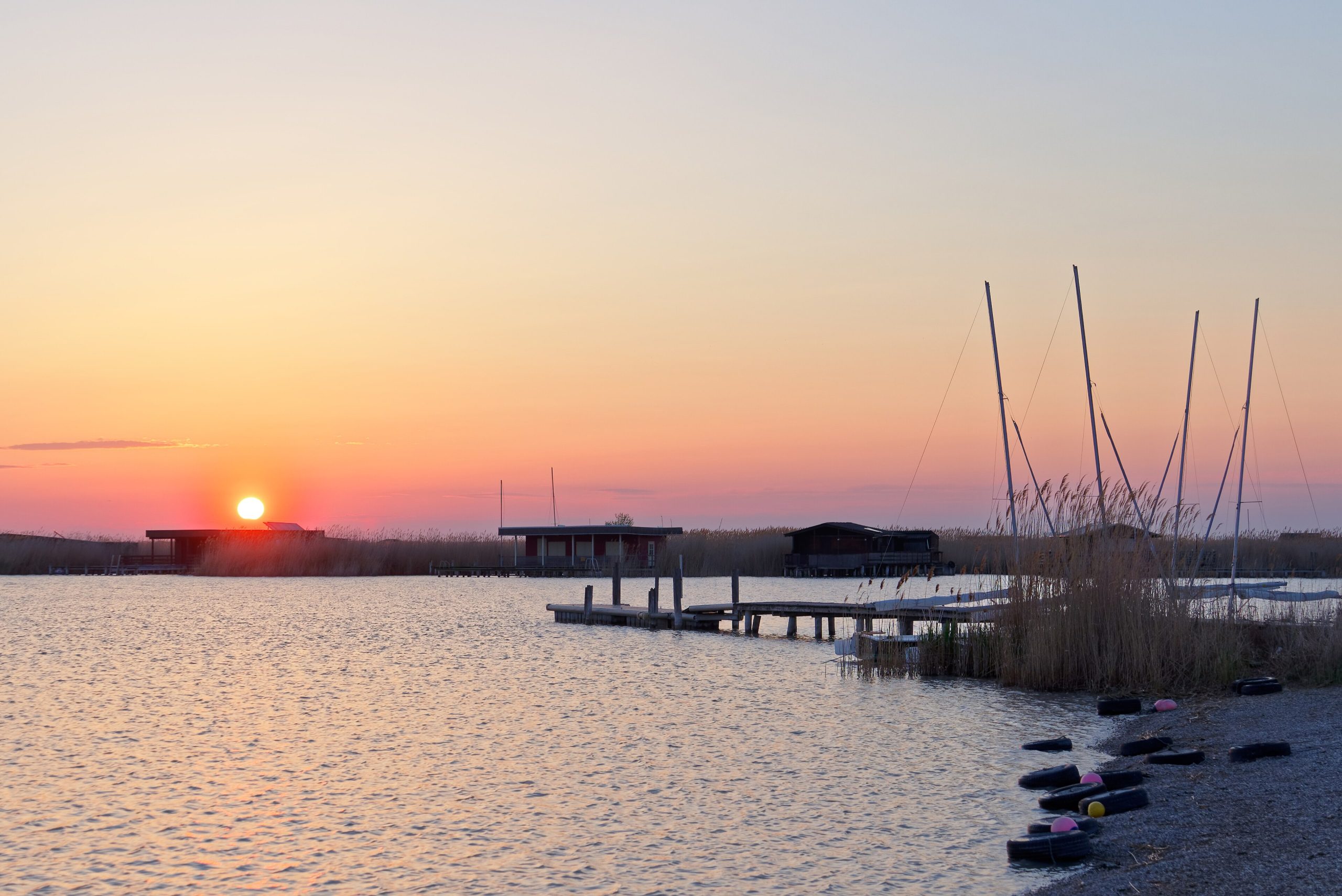
Neusiedler See
Neusiedler See, Jakub Hałun, CC BY-SA 4.0, via Wikimedia Commons

Location and Arrival at Neusiedler See

Europe’s largest steppe lake lies in the border area between Austria and Hungary. With an area of 315 km², it is one of the few steppe lakes in Europe. From Vienna, you reach Neusiedl am See in just 40 minutes with the ÖBB regional trains. The trains run half-hourly to hourly from Vienna Main Station. By car, the A4 leads directly into northern and central Burgenland via Vienna.

Special Features of Neusiedler See

The average depth is only 1 meter, with a maximum of 2 meters. This allows the water to warm up to 21 to 27 degrees. The vast reed belt covers 180 km² and is the second largest in Europe after the Danube Delta. Since 2001, the region has held UNESCO World Heritage status. With 300 days of sunshine a year, Burgenland is the warmest region in Austria.

Activities at Neusiedler See

Constant winds make the lake a paradise for sailors and windsurfers. The Neusiedler See-Seewinkel National Park is home to around 350 bird species. The unique salt pans provide a rare habitat for avocets and black-winged stilts. The 125-kilometer-long Neusiedler See cycle path encircles the entire lake.

Insider Tip for Neusiedler See

The “Hölle” preservation zone south of Podersdorf features grey geese and Mangalitza pigs. You can best explore hidden reed channels by e-boat early in the morning or before sunset.

Lakes in Austria Map – Overview and Planning Tips

*** soon availabe ***

Austria has a total of over 2,000 different lakes. Their distribution shows clear regional focal points that will make your route planning easier.

Carinthia leads with the highest density of lakes. Wörthersee, Faaker See, Weißensee, Millstätter See, and Ossiacher See are all close to each other. A road trip ideally starts in Klagenfurt and connects several lakes in just a few hours of driving. The Gerlitzen Alpe offers a breathtaking panoramic view of the Carinthian lake landscape.

The Salzkammergut is concentrated in Upper Austria and Salzburg. Here, Attersee, Traunsee, Wolfgangsee, Mondsee, and Hallstätter See are lined up together. The medieval adventure castle Hohenwerfen and the imperial city of Bad Ischl complement your lake tour. It is best to visit Hallstatt early in the morning to avoid the tourist hustle and bustle.

Tyrol scores with the Achensee as the largest lake in the region. You can reach it from Jenbach in three-quarters of an hour.

Burgenland offers a completely different experience with Lake Neusiedl. The shallow steppe lake is only 40 minutes from Vienna.

The best time for swimming lakes is June to August. For hiking and photography, May and September are particularly suitable.

Conclusion

Austria’s lakes offer you almost endless possibilities for your next holiday. The choice of the perfect lake depends on your preferences: Do you want to swim in the warm water of Lake Klopein, enjoy the turquoise Caribbean atmosphere at Lake Faak, or would you prefer the peace and quiet at the natural Lake Weissen?

It’s best to start with a region that particularly appeals to you. Carinthia is perfect for a road trip between several lakes, while the Salzkammergut combines cultural heritage with natural beauty. With the Lakes in Austria map, you can plan your route effortlessly.

Don’t forget to book your accommodation early, especially in the summer months of June, July, and August. Have fun exploring these natural paradises!

FAQs

Q1. Which lakes in Austria are considered special insider tips for beach holidaymakers?
Less well-known swimming lakes include Walchsee in Tyrol with water temperatures of up to 24 degrees, the natural Weißensee in Carinthia with drinking water quality, the Irrsee in Upper Austria under nature protection, and the Altausseer See in Styria. These lakes offer crystal-clear water and are significantly quieter than the famous tourist magnets.

Q2. Which Austrian lake is best for warm swimming water?
Lake Klopein (Klopeiner See) in southern Carinthia reaches temperatures of up to 29 degrees in summer and is considered the warmest swimming lake in Europe. Lake Wörthersee also warms up to 22-27 degrees, while Lake Mondsee, at up to 27 degrees, is also among the warmest swimming lakes in Austria.

Q3. Which lakes in Austria offer particularly clear water and drinking quality?
Lake Achen has near drinking quality with a visibility of up to 10 meters. Lake Atter reaches as much as 25 meters of visibility, while Lake Weissen stands out as Europe’s most natural alpine lake with drinking quality. Lake Faak also often exceeds drinking water standards and carries the title “Cleanest swimming lake in the Alpine region.”

Q4. Where can you find quiet lakes without large crowds of tourists?
Lake Weissen in Carinthia is particularly quiet and natural thanks to the ban on motorboats. Walchsee in Tyrol is considered popular but not overcrowded. The neighboring Turnersee near Klopeiner See is located in the middle of a nature reserve and offers significantly more peace than the better-known lakes.

Q5. Which Austrian lakes are particularly suitable for water sports enthusiasts?
Lake Achen offers ideal conditions for sailing and surfing thanks to constant winds. Lake Atter is a paradise for sailors with the legendary Rosenwind. Lake Traun (Traunsee) is considered a sailing paradise with challenging winds and offers the widest range of water sports of all Austrian lakes, from wakeboarding to stand-up paddling.

References & Links

Millstaettersee.info
Holiday at Lake Faak
Arriving at Klopeinersee
Diving in Ossiacher See
Traunsee (Wikipedia)
Millstätter See Shipping
Bathing spots and beach baths at Mondsee
Around the Mondsee
The region around the Traunsee

Johannes Brahms in Austria

Falkensteiner Schlosshotel Velden am Wörthersee

The Sound of Austria

Austrian Castle Guide: Discover Historic Fortresses and Hidden Palaces

Burg Hohenwerfen
Hohenwerfen Castle, Werfen, Austria. Arne Müseler, CC BY-SA 3.0 DE, via Wikimedia Commons

Austria boasts over 1,000 castles, palaces and fortresses. This makes it one of Europe’s richest destinations for anyone seeking an authentic Austrian castle experience. These structures range from fairytale-like alpine fortresses to grand Baroque Austrian palaces. Notable sites like Schönbrunn Palace and Eggenberg Palace have earned UNESCO World Heritage status. You might be interested in visiting a famous Austrian castle, finding an Austrian castle in mountains, or staying overnight at one of the unique Austrian castle hotels. We’ve created this complete guide to direct you through Austria’s most impressive historic sites.

Understanding Austria’s Castle Heritage

Medieval Fortresses vs. Baroque Palaces

Austrian castles fall into two distinct categories that reflect different historical purposes and architectural philosophies. Medieval fortresses served as defensive strongholds, built during times when protection from invaders was paramount. Hohensalzburg Fortress exemplifies this category. Construction began in 1077 under Archbishop Gebhard von Helfenstein as a simple bailey with wooden walls. The fortress grew over centuries. Ring walls and towers were added in 1462, and further expansion occurred between 1495 and 1519. Today, it measures 250 meters long and 150 meters wide, making it one of Europe’s largest medieval castles.

Baroque palaces emerged during the 17th and 18th centuries as symbols of wealth and cultural refinement rather than military might. Schönbrunn Palace served as the biggest summer residence of Habsburg rulers and featured 1,441 rooms. The Baroque style emphasizes decorative elements like sculptures, marble, stucco and gilded objects. Belvedere Palace, designed by Johann Lukas von Hildebrandt in the 18th century, showcases this ornate esthetic with its striking yellow facade and grand interiors that house Austrian art collections.

The Habsburg Legacy in Austrian Architecture

The House of Habsburg shaped Austrian architecture over three centuries and left an indelible mark on the country’s cultural map. Their patronage transformed Vienna and other Austrian cities into showcases of imperial power. Schönbrunn Palace demonstrates this influence, with its history spanning over 300 years and reflecting the changing tastes of successive Habsburg monarchs.

Habsburg architecture introduced the concept of Gesamtkunstwerk, a masterly fusion of many art forms where gardens, buildings and interior design are the foundations of an organic whole. This approach meant palaces couldn’t be separated from their surrounding landscapes. The baroque gardens at Schönbrunn, with structures like the Gloriette and Roman ruins, were designed to glorify the House of Habsburg while paying homage to nature.

The Hofburg Imperial Palace in Vienna’s heart served as the Habsburg winter residence for over 600 years. It now functions as the official residence of Austria’s President while offering public access to imperial apartments and the Sisi Museum.

UNESCO World Heritage Castle Sites

Two Austrian palaces have earned UNESCO World Heritage status for their exceptional cultural significance. Schönbrunn Palace received this designation in 1996 (↱ UNESCO World Heritage List) and was recognized as an outstanding Baroque ensemble that preserves evidence of modifications across several centuries. The palace represents Habsburg power from the late 17th to early 20th century and embodies the ascent and splendor of the Habsburg Empire at its peak in the early 18th century.

Eggenberg Palace in Graz earned UNESCO recognition as part of the City of Graz Historic Center. The palace reflects artistic and architectural movements from Germanic and Balkan regions and has served as a cultural crossroads for centuries. The castle and its gardens have managed to keep satisfactory architectural integrity, with the baroque interior on the first floor showing excellent authenticity.

Top Austrian Castles by Province

Each Austrian province offers distinct castle experiences shaped by local history and geography. Vienna’s imperial grandeur contrasts with alpine fortresses perched on mountain peaks. The regional diversity provides options for every type of castle enthusiast.

Vienna’s Imperial Palaces

Schönbrunn Palace draws 3,800,000 visitors annually and is Austria’s most visited palace complex. Multiple ticket options range from €28 for State Apartments to €38 for the full Palace Tour. The Hofburg Palace complex served as the Habsburg residence for 600 years. It now functions as one of the world’s biggest palace complexes. You’ll find the Sisi Museum, Imperial Apartments, and the Silver Collection within its walls. Each offers distinct views on Habsburg court life.

Schoenbrunn Palace Vienna
Schönbrunn Palace, Vienna

Salzburg’s Historic Fortresses

Salzburg province presents four major castle experiences managed collectively. Hohensalzburg Fortress covers 32,000 square meters and ranks as one of Central Europe’s largest castle complexes. Adult admission costs €15.50, with children aged 6-14 paying €6.30. Hohenwerfen Castle stands 155 meters above the Salzach Valley and features daily falconry demonstrations at its historic Salzburg Falconry Center. Mauterndorf Castle serves as both a regional museum and cultural center further south. Medieval banquet experiences are available at the Burgschenke. Klammstein Castle in Gastein Valley opens daily from 11 am, Tuesday through Sunday. It offers both museum tours and a castle tavern.

Burg Mauterndorf Castle Salzburg
Burg Mauterndorf Castle Salzburg. Nxr-at, CC BY-SA 4.0, via Wikimedia Commons

Lower Austria’s Castle Treasures

Lower Austria combines dramatic ruins with fortresses that remain intact. Aggstein Castle Ruins sit 300 meters above the Danube Valley and offer stunning Wachau panoramas. The site features the legendary Rosengärtlein, a narrow rock needle where prisoners were held allegedly. Dürnstein Castle ruins gained fame as the 12th-century prison of English King Richard the Lionheart. Kreuzenstein Castle sits 265 meters above sea level near Leobendorf. It was reconstructed in the 19th century using medieval structures purchased from different parts of Europe. Adult tickets cost 12 euros. Heidenreichstein Castle remains Lower Austria’s largest preserved medieval moated castle and is still accessible via two original drawbridges.

Castle ruins of Aggstein, Wachau, Lower Austria
Castle ruins of Aggstein, Wachau, Lower Austria. Uoaei1, CC BY-SA 3.0 AT, via Wikimedia Commons
Dürnstein in der Wachau, Niederösterreich
Dürnstein in the Wachau, Lower Austria. Uoaei1, CC BY-SA 3.0, via Wikimedia Commons
Burg Kreuzenstein in der niederösterreichischen Marktgemeinde Leobendorf
Kreuzenstein Castle in the Lower Austrian market town of Leobendorf. C.Stadler/Bwag, CC BY-SA 4.0, via Wikimedia Commons

Styria and Carinthia Highlights

Western view of the castle in the Styrian market town of Riegersburg
Castle of Riegersburg. C.Stadler/Bwag, CC BY-SA 4.0, via Wikimedia Commons

Riegersburg Castle dominates the Styrian landscape from its position 450 meters high on an extinct volcano. The fortress features 3 kilometers of walls, 5 gates, and 108 rooms. Twenty-five rooms are open as museums. Herberstein Castle has been owned by the Herberstein family for 21 generations and combines historic architecture with 16th-century gardens.

Burg Hochosterwitz, Gemeinde Sankt Georgen am Längsee, Kärnten, Österreich
Hochosterwitz Castle, municipality of Sankt Georgen am Längsee, Carinthia, Austria. Uoaei1, CC BY-SA 4.0, via Wikimedia Commons (modified)

Hochosterwitz Castle crowns a 172-meter dolomite rock near Sankt Georgen am Längsee in Carinthia. Visitors pass through 14 fortified gates along a winding access road. Landskron Castle sits 658 meters above sea level and conducts regular flying demonstrations at its falconry center.

Burg Landskron
Landskron Castle in Villach, Carinthia. C.Stadler/Bwag, CC BY-SA 4.0, via Wikimedia Commons

Tyrol and Vorarlberg Mountain Castles

Ambras Castle in Innsbruck houses the Habsburg Portrait Gallery with over 200 portraits and extensive glass collections. Tratzberg Castle retains original furnishings from 1500, including late Gothic cupboards and inlaid tables. The castle offers both traditional guided tours and virtual reality experiences.

Schloss Tratzberg Königinzimmer
Queen’s Room (Tratzberg Castle). Ricardalovesmonuments, CC BY 4.0, via Wikimedia Commons

Schattenburg Castle in Feldkirch was built in 1200 by Duke Hugo von Montfort. It ranks among Central Europe’s best-preserved medieval fortresses. The castle features 18 rooms spread over 3 floors and is dedicated to Feldkirch’s history. Neu-Ems Castle (Schloss Glopper) sits 666 meters above sea level in Hohenems. Alt-Ems Castle Ruins stretch as Austria’s longest medieval castle at 740 meters elevation.

Schattenburg Feldkirch
Schattenburg Feldkirch. Michielverbeek, CC BY 4.0, via Wikimedia Commons (modified)

Visiting Austrian Castles: Practical Guide

You need to pay attention to seasonal schedules and booking requirements when planning your Austrian castle visits. Many historic sites adjust operations throughout the year.

Opening Hours and Seasonal Schedules

Castle operating hours vary substantially by season and location. Hohensalzburg Fortress operates year-round and opens from 9:30 AM to 5:00 PM during January through April and October through December. Extended hours from 8:30 AM to 8:00 PM run in May through September. Schönbrunn Palace maintains daily operations from 8:30 AM to 5:00 PM and extends to 6:00 PM during July and August.

Mountain fortresses follow stricter seasonal patterns due to weather conditions. Hohenwerfen Castle opens only from spring to late fall, from April through early November, and closes during winter months. Hochosterwitz Castle operates from May to October. Hellbrunn Palace and its famous trick fountains remain closed from November through March and reopen with varying hours from 9:30 AM through the warmer months.

Peak visiting times occur between 11 AM and 2 PM at major sites, especially at Belvedere Palace. You can avoid crowds if you arrive early or late in the day. Online ticket booking has become essential at popular destinations. Schönbrunn Palace recommends advance purchases due to very high visitor numbers, and short-term visits without prior booking are no longer guaranteed.

Entrance Fees and Tour Options

Pricing structures differ based on access levels and included amenities. Adults pay €20 to get standard admission at Schönbrunn, with children from age 6 paying €12, though children under 6 enter free. The Sisi Museum and Imperial Apartments require fixed admission times, with tickets at €20 for adults and €12 for children.

Students up to age 25 receive concessions by presenting valid international student identity cards (ISIC) at museum ticket desks. Disability discounts apply with valid identification, and visitors with 50% or more disability receive reduced admission that includes one accompanying person.

Photography Rules and Visitor Etiquette

Photography policies separate between interior and exterior spaces. Palace rooms at locations like Schönbrunn and the Hofburg prohibit photography whatever equipment type you use. This restriction protects delicate 18th-century furnishings and artwork from light damage.

Garden areas and palace courtyards welcome unlimited photography with no equipment restrictions. Museums prohibit tripods, selfie sticks, flash and similar photographic equipment. You cannot carry food and beverages into exhibition rooms.

Accessibility for Families and Seniors

Barrier-free access exists via funiculars and cable cars at mountain fortresses. Hohensalzburg offers accessibility through the FestungsBahn, but the footpath is too steep for wheelchairs. Hohenwerfen provides an inclined elevator, though only the castle courtyard remains barrier-free, and interior tours require navigation of 300 steps.

An elevator in the bell tower provides access to the castle courtyard, armory exhibition and marionette museum at Hohensalzburg. Visitors with walking impairments receive tablets with video tours of indoor areas at service centers. Those with hearing impairments can get tablets with video guides in sign language. Assistance dogs on leashes are permitted at all fortresses.

Schönbrunn Palace offers complete wheelchair accessibility. Lifts provide access to all exhibition areas, and three dedicated parking spaces are available at the main gate.

Austrian Castle in Mountains: Alpine Fortress Adventures

Alpine fortresses represent Austria’s most dramatic architectural achievements. They combine military engineering with breathtaking natural settings. Three castles stand out for their strategic mountain positions and remarkably preserved defensive systems.

Burg Hohenwerfen in Salzach Valley

Schloss Hohenwerfen, Werfen, Austria
Schloss Hohenwerfen. Also called Burg Hohenwerfen / Festung Hohenwerfen. Diego Delso, CC BY-SA 4.0, via Wikimedia Commons

Hohenwerfen sits 155 meters above the Salzach Valley, roughly 40 kilometers south of Salzburg. The fortress dates back over 900 years. Archbishop Gebhard built it between 1075 and 1078 as a fortified castle. Guided tours take you through hidden corners and secret passages, from the torture chamber to the panoramic bell tower. The fortress also houses two exhibitions: “Mythos Jackl – Sorcerers and Witches” explores witch trials, while the Austrian Falconry Museum covers falconry’s history.

Daily bird of prey demonstrations remain the highlight. Falcons, vultures, and eagles perform at 11:15 AM and 3:15 PM from April through early November. The falconers wear historical robes and explain this centuries-old art practiced at the historic Landesfalkenhof. These professionals work full-time, having passed hunter and falconer examinations. Some have completed forestry or veterinary training.

Kufstein Fortress in Tyrol

Kufstein Fortress commands attention at 507 meters above sea level. Emperor Maximilian I conquered it in 1504. He required his two most powerful cannons, Purlepaus and Weckauf, to be rafted from Innsbruck. The fortress served as a state prison during the Austrian-Hungarian Empire. It housed prominent prisoners including Hungarian author Ferenc Kazinczy in cells within the Kaiser Tower, which features walls seven meters thick.

The Heroes’ Organ was installed in 1931 as a World War I memorial. It contains 4,948 pipes and 46 stops. Daily concerts at noon fill Kufstein with organ music that can be heard up to ten kilometers away when wind conditions permit. The fortress well drops at least 70 meters deep and illustrates the self-sufficiency required for medieval sieges.

Hochosterwitz Castle in Carinthia

Hochosterwitz crowns a 172-meter dolomite rock. You can see it from 30 kilometers away on clear days. Its 14 fortified gates create a tactical masterpiece designed to shatter enemy momentum through blind curves and firing platforms. Legend maintains the castle was never taken by force, with each gate equipped with different defensive mechanisms.

An inclined funicular installed in 1993 covers 105 meters of elevation in 95 seconds. Walking the 620-meter pathway through all 14 gates takes 30 to 45 minutes. The armory holds a remarkable collection including a 14th-century bombard, possibly among the world’s earliest firearms.

Experiencing Castle Life Today

Modern castle experiences extend way beyond simple sightseeing and offer immersive ways to involve Austria’s medieval and baroque heritage.

Guided Tours and Historical Reenactments

Guided tours reveal areas that casual visitors cannot access. Tours at Hohenwerfen explore hidden corners, secret passages and the deepest dungeons. Burg Bernstein offers 50-minute historic tours conducted mostly outdoors. Entrance fees include a glass of Almásy sparkling wine in the Renaissance hall. Schallaburg Castle provides exclusive 75-minute winter tours that show areas not usually available.

Historical reenactments bring medieval life to vivid reality. Actors portray historical figures at various castles. Young visitors slip into roles of knights or ladies-in-waiting. Moosham Castle hosts cultural festivals and historical reenactments.

Castle Museums and Exhibitions

Fortress Hohensalzburg houses the best-preserved Gothic secular buildings in Europe within the Princes’ Rooms. The fortress contains several museums. The Great Armory features interactive attack and defense models. The Marionette Museum showcases UNESCO intangible cultural heritage.

Concerts and Special Events at Palaces

Classical concerts occur at historic venues. The Schönbrunn Palace Orangery hosts the Schoenbrunn Palace Orchestra with selections from Mozart and Strauss. Mozart performed there in 1786. Mirabell Palace offers concerts in its baroque marble hall, one of the world’s most beautiful concert venues.

Staying Overnight in Castle Hotels

Overnight stays transform castle visits into experiences through time. Old walls carry stories from past centuries. Creaking floors and light-flooded parlors bring history alive. Austria’s castle hotels combine historic charm with contemporary comfort.

Conclusion

Austria’s castle landscape offers something for every traveler, from Vienna’s imperial grandeur to alpine fortresses perched on mountain peaks. These sites are well preserved, and you can explore medieval defense systems and Habsburg heritage in all nine provinces.

We’ve covered the practical details to help you plan visits, whether that means booking timed tickets at Schönbrunn or staying overnight in castle hotels. Austrian castles aren’t just museums frozen in time but living spaces where history meets contemporary experiences.

Start with the castles matching your interests, and you’ll find out why Austria remains Europe’s premier destination for fortress enthusiasts.

FAQs

Q1. What is the difference between Austrian medieval fortresses and Baroque palaces?
Medieval fortresses were built primarily for defense and protection from invaders, featuring thick walls, strategic positions, and military architecture. Baroque palaces, on the other hand, emerged in the 17th and 18th centuries as symbols of wealth and cultural refinement, emphasizing decorative elements like sculptures, marble, stucco, and gilded objects rather than military function.

Q2. How much does it cost to visit Schönbrunn Palace?
Standard admission to Schönbrunn Palace costs €20 for adults and €12 for children aged 6 and above, while children under 6 enter free. Students up to age 25 can receive concessions by presenting a valid international student identity card. The palace offers various ticket options ranging from €28 for State Apartments to €38 for the full Palace Tour.

Q3. Are Austrian castles wheelchair accessible?
Accessibility varies by castle. Schönbrunn Palace offers complete wheelchair accessibility with lifts to all exhibition areas and dedicated parking spaces. Mountain fortresses like Hohensalzburg and Hohenwerfen provide funiculars or inclined elevators to reach courtyards, though interior tours may have limitations. Many castles offer tablets with video tours for visitors with mobility or hearing impairments.

Q4. What are the best times to visit Austrian castles to avoid crowds?
Peak visiting times at major castles occur between 11 AM and 2 PM. Arriving early in the morning or later in the afternoon helps avoid crowds. Online ticket booking in advance is essential at popular destinations like Schönbrunn Palace, as same-day visits without prior booking are no longer guaranteed due to high visitor numbers.

Q5. Can you take photos inside Austrian castles?
Photography policies differ between interior and exterior spaces. Inside palace rooms at locations like Schönbrunn and the Hofburg, photography is strictly prohibited to protect delicate furnishings and artwork from light damage. However, garden areas and palace courtyards welcome unlimited photography. Tripods, selfie sticks, and flash equipment are generally not permitted in museum areas.

Links

Wikipedia: Hohensalzburg Fortress
Wikipedia: Schönbrunn Palace
Hohensalzburg Fortress

Royal Palace Tours in Austria

Graz Historical Sites & Attractions

The Sound of Austria

The 10 Best Austrian Music Festivals in 2026 (Complete Guide)

Planning your Austria music festival adventure for 2026? You’re at the right place. Austria hosts over 15 festivals throughout the year, and some attract up to 200,000 visitors.

Austrian festivals offer something for everyone. Whether you love rock, electronic, or classical music, this piece covers the 12 best Austria festival options. We’ll walk you through what to expect, pricing details, and why each one deserves a spot on your calendar.

Nova Rock Festival

Nova Rock Festival
Foto: Stefan Kuback, Nova Rock Festival, novarock.at

What to Expect at This Austrian Music Festival

Nova Rock stands as Austria’s largest rock festival and draws massive crowds to its open-air venue since 2005. The 2024 edition attracted around 200,000 attendees (↱ Wikipedia: Nova Rock Festival) over four festival days. Picture multiple stages blasting everything from hard rock to heavy metal across sprawling fields.
The atmosphere buzzes with energy. You’ll find activities beyond the main stages. The Ottakringer beer garden lets you grab a cold drink between sets. The ÖBB Roller Disco offers free roller skate rentals if you want to party on wheels.

Brand activations fill the festival grounds. The Crunchips XXL Crunchpong Area lets you challenge friends to oversized pong games. Casa Bacardí brings Caribbean vibes with hula hoop battles and limbo competitions. Jägermeister Orange Night turns evening into a fruity, ice-cold party experience.

When and Where

Mark your calendar for June 11 to 14, 2026 (Thursday through Sunday). Nova Rock takes place at Pannonia Fields in Nickelsdorf. The venue is located in Burgenland, Austria’s easternmost state. The venue sits near the Hungarian and Slovak borders and makes it available from multiple countries.

Gates open Tuesday at noon and close Sunday at noon. Stage performances run Thursday through Saturday from 1 PM to midnight. Children aged 8 and above can attend with proper supervision.

Genre Focus and Performers

This Austria music festival specializes in hard rock, heavy metal and punk rock. The 2026 lineup features four confirmed headliners: Volbeat, The Cure, Iron Maiden and Bring Me The Horizon. Bad Omens, Sabaton, Papa Roach and Architects join as supporting acts.
The Offspring also appears on the bill. Three Days Grace moved their performance to Sunday due to travel issues. Volbeat returns for their seventh Nova Rock appearance and third time headlining.

More than 100 artists will perform across multiple stages throughout the four days. The festival announces lineup details in phases. Additional acts get confirmed closer to the event date.

Pricing Information

Early Bird festival passes give you the best deal if you book fast. The festival introduced a “Day of your Choice” ticket for 2026. This new option lets you decide which day to attend after purchase. You don’t need to pre-register and can still use it even if specific day tickets sell out.

VIP packages come with extra perks. The Diamond VIP & Hotel Package has four nights at a hotel (June 11-15 arrival and departure), breakfast each morning, VIP festival passes, daily shuttle service to the festival and access to exclusive VIP areas. Some packages have champagne reception and spa access at St. Martins Therme.

Glamping options sold out early. Rock Chalet and Desert Lodge accommodations are no longer available. Standard camping remains available with festival pass purchase.

Top Reasons to Visit

Nova Rock puts you close to major Austrian music festival action without the hassle of urban festivals. The Pannonia Fields location provides excellent acoustics and space to move freely.
Shuttle busses run to Podersdorf for lake activities on Thursday, Friday and Saturday at 10 AM. They return by 4 PM. The roundtrip costs € 10,- per person. Your festival wristband gets you discounted beach entry at about € 6,-. Nova Rock attendees also receive 10% off day tickets at St. Martins Thermal Baths.
The festival’s autograph sessions let you meet performers between sets. FM4 radio station operates a fan post office where you can write messages to your favorite bands. Free music workshops teach guitar and drumming skills to youth participants.

Electric Love Festival

Electric Love Festival
Line-up Screenshot: www.electriclove.at

What to Expect at This Austrian Music Festival

Electronic beats pulse through Alpine valleys at Electric Love Festival. Since 2013, this Austria music festival has transformed the Salzburgring race track into a colorful electronic music playground. The venue spreads across multiple hectares and surrounding cow meadows serve as camping areas.

You’ll experience 200 artists performing across seven custom-designed stages. Each stage creates its own atmosphere with state-of-the-art sound systems and light shows. The Mainstage sits in the race track paddock and hosts the biggest names. Club Circus brings underground vibes indoors. Hard Dance Factory pumps harder styles and Heineken Starclub features hip-hop and rap artists.

Festival organizers also offer three camping options: Basic, Comfort, and Caravan. New to recent editions, ELF Hotels provide city accommodation in Salzburg with free shuttle service to festival grounds. An on-site supermarket stocks everything from cold beer to camping supplies.
The festival opens with a traditional ceremony led by Electric Love resident Felice and accompanied by a local choir and orchestra. Expect production value that matches the music.

When and Where

Electric Love runs July 9 to 11, 2026, with a warm-up party on July 8. The festival takes place at Salzburgring in Plainfeld, Austria. The race track opened in 1969 between Koppl and Plainfeld near Salzburg in the Salzkammergut lake district.
Gates open for four days of camping. The location sits close to Salzburg Airport and makes international travel straightforward. You can explore historic Salzburg city before or after the festival.
Nearby lakes Fuschlsee and Wolfgangsee offer daytime swimming spots. The Alpine backdrop creates a festival setting that blends electronic music with mountain views.

Lake Wolfgang in the Austrian Salzkammergut region
Image by Karl Egger (via Pixabay)

Genre Focus and Performers

This Austrian music festival covers the full electronic music spectrum. Genres have EDM, Techno, Hardstyle, Bass Music, and Hip-Hop. Past headliners have featured Armin van Buuren, Hardwell, David Guetta, Martin Garrix, and Tiësto.
The 2025 lineup had Dom Dolla, Major Lazer, Steve Aoki, Alan Walker, and Timmy Trumpet. Radio Rudina from Vienna hosted the BlueBoxx stage and Blacklist from Bootshaus Cologne took over Club Circus.

Different stages cater to specific tastes. Q-Dance hosted the harder styles stage from 2015 to 2019. The Shutdown Uptempo Cage plays tracks above 200 BPM. Whether you prefer house, techno, or bass, you’ll find your sound here.

Pricing Information

Festival passes range from about € 240,- to 340,- . Single-day passes start at about € 90,- and 3-Day VIP Gold experiences cost about € 550,-

VIP options have three tiers: Bronze, Silver, and Gold. The CUPRA Platin VIP Lodge costs about € 270,- per day and offers the best Mainstage view. This package has dedicated bars, exclusive drinks with bottle service, table and lounge reservations, private toilets, and coat check.
Tables seat four people with € 300,- consumption credit that comes with the package. Lounges accommodate six people with about  € 1,000 consumption credit. Note that consumption credits are non-refundable.
Caravan camping requires a vehicle ticket plus individual camping tickets. Vehicles must not exceed 3.5 tons total weight, 8 meters combined length, and 3 meters width.

Top Reasons to Visit

Electric Love combines festival excitement with vacation potential. The proximity to Salzburg lets you experience both electronic music and Austrian culture. The festival attracts visitors from all over Europe given that the Salzburgring location sits near multiple borders.
The Organics Beach area opens before the main festival starts and offers yoga and creative sessions. This separated event provides activities beyond the main stages.

The Austrian music festival maintains high organization standards with shuttle busses, efficient bar service, and clear navigation. Festival attendees describe the campsite atmosphere as a massive family gathering. The mountain views from camping areas add natural beauty to the electronic music experience.

Frequency Festival

Frequency Festival
Frequency Festival, www.frequency.at

What to Expect at This Austrian Music Festival

Frequency Festival brings a world-class lineup to a riverside setting just outside St. Pölten. Around 80,000 festival-goers gather at Green Park to celebrate over three days. The atmosphere runs wild, especially when darkness falls and campgrounds turn into all-night party zones.
Seven stages showcase different sounds across the festival grounds. The camping experience stands out as one of the best in Austria music festival culture. Restrooms, showers and other facilities keep things comfortable. Glamping options offer luxury tents with private bathrooms if you prefer more comfort.

The relaxation zone gives you a break from the high-energy stages. Hammocks and cozy lounging areas create a chill atmosphere. Art installations dot the festival grounds, and yoga classes run throughout the weekend. Frequency balances party vibes with wellness activities.
Green Park provides stunning views as your festival backdrop. Cashless payment systems, wheelchair access and water stations keep logistics simple. The festival operates food courts, first aid stations and lost-and-found desks.

When and Where

Frequency Festival runs August 20-22, 2026. The venue sits at Green Park in St. Pölten, Austria, at Kelsengasse 9. St. Pölten lies close enough to Vienna for easy access but far enough to feel like an escape.
The festival requires attendees to be 12 years or older. Check the official website as soon as possible to see additional restrictions. Camping opens before the first day of music and gives you time to set up your spot and meet neighbors.

Motorhomes and campers can park at designated areas. The riverside location adds natural beauty to the Austrian music festival experience.

Genre Focus and Performers

This Austria festival covers multiple genres rather than sticking to one style. Hip-hop dominates with 16 artists, followed by 11 pop acts and 7 rock performers. Alternative, R&B, reggae and European music round out the lineup.
Twenty One Pilots headlines the final day on August 22. Lorde performs on the opening night. Other major names include Kraftklub, Sido, Paul Kalkbrenner and Tom Odell. Natasha Bedingfield, bbno$ and Ashnikko also appear on the bill.

To cite an instance, August 20 features Kraftklub, Lorde, Fontaines D.C. and Zara Larsson. August 21 brings Sido, Paul Kalkbrenner and Sub Focus. The festival spreads 38 total artists across three days.

Pricing Information

Camping packages come in different tiers. The Black & Fresh 4XL package requires a € 100,- deposit collected on-site and returned when you return equipment in good condition. Wooden huts accommodate up to four people. These huts require you to purchase festival passes separately.
Caravan tickets only work with valid festival passes. You cannot buy caravan parking alone. VIP festival passes and BFF festival passes pair with various camping options.

Padlock deposits cost about € 20,-, debited through the cashless system. You get your deposit back at checkout if you return the padlock in perfect condition. The festival provides these padlocks to lock wooden huts.

Top Reasons to Visit

Frequency offers one of Austria’s best camping experiences at an Austrian music festival. The variety of genres means you’ll find new artists outside your usual taste. The campground atmosphere creates a community feeling among attendees.
Glamping provides luxury if you want comfort without sacrificing the festival experience. The relaxation zone and yoga classes balance the party energy. Art installations add visual interest beyond the music stages.

Green Park’s location near St. Pölten gives you access to Austrian culture if you arrive early or stay late. The festival’s amenities make the experience smooth thanks to professional organization.

Danube Island Festival

Donauinselfest
Donauinselfest – Manfred Werner (Tsui), CC BY-SA 3.0, via Wikimedia Commons

What to Expect at This Austrian Music Festival

Free admission to Europe’s largest open-air festival sounds too good to be true. Yet Danube Island Festival delivers exactly that.

Around 3 million visitors (↱ Wikipedia: Donauinselfest) gather over three days on Vienna’s Danube Island. Peak times see 250,000 people fill the grounds at once. The festival area stretches 4.5 kilometers between two bridges. You’ll find 16 stages scattered throughout this massive space.
Security checks happen at entry, but no tickets required. The festival generates € 40 million in city revenue despite free admission. To cite an instance, increased tourism during festival weekend boosts Vienna’s economy.

Programming keeps stages busy from afternoon until midnight with over 700 hours of content. You’ll find everything from international stars to local acts. The 2025 edition featured Milky Chance, Kim Wilde, No Angels and Steel Panther. Austrian artists like AVEC and Josh also performed.

Dedicated stages run children’s programming until 4 PM with clowns, magic shows and interactive activities. On top of that, the festival offers sports courses, karaoke stages, beach volleyball and yoga sessions. Democracy Island hosts interviews and hands-on activities.

Food stands number over 250. They serve Austrian and international cuisine including Thai, Greek and Italian options.

When and Where

Mark July 3-5, 2026 on your calendar. The festival happens at Donauinsel in Vienna, Austria. The location sits between Nordbrücke and Reichsbrücke bridges.

Friday programming starts around 5 PM. Saturday runs throughout the day. Sunday wraps up around 11 PM. All ages can attend this Austria music festival.

Genre Focus and Performers

This Austrian music festival covers every genre imaginable. Rock, pop, electronic, opera, Schlager, country, metal and hip-hop all get stage time. Past performers included The Backstreet Boys, Anastacia and Sean Paul.

The 2025 lineup brought Camo & Krooked with Vienna Symphony Orchestra performing Johann Strauss works. Milow performed an inclusion concert with sign language translation.

Pricing Information

Admission costs nothing. This Austria festival remains free for all visitors.

Top Reasons to Visit

Free access to international stars makes this Austrian music festival unbeatable value. The diversity means everyone finds something they love. Accessibility features include shuttle services, sign language interpretation and quiet zones. Family-friendly programming welcomes all ages. Public transport via U1 and U6 subway lines connects directly to festival grounds.

Woodstock der Blasmusik

Woodstock der Blasmusik
Woodstock der Blasmusik – Lederhosnamore, CC BY-SA 4.0, via Wikimedia Commons

What to Expect at This Austrian Music Festival

Brass instruments take center stage at Europe’s largest brass music festival. Woodstock der Blasmusik draws 100,000 visitors to the Innviertel region. The 2026 edition marks the festival’s 14th year since its 2011 founding.
You’ll find 150 acts performing across 9 stages over four days. The main stage, Buffet Crampon Main Stage, hosts the biggest names. Other venues include Demmelbauer’s Tanzboden, Schpüwiesn, Allerhand Stage, Woodstock Stadel, and Kraut & Ruabm Arena.

Workshops teach music skills throughout the weekend. Sports activities include football, basketball, and volleyball. Cultural performances showcase traditional Austrian dance and music. Art exhibitions display traditional handicrafts and paintings.
The festival atmosphere centers on families. Children under 14 get free entry. Activities run for young attendees, making this Austria music festival welcoming for all ages.

When and Where

Woodstock der Blasmusik runs July 2-5, 2026. The venue sits at Kammer 5, 4974 Ort im Innkreis in Upper Austria.

The Innviertel location connects easily by car or train. Take the Suben exit from Passau and follow B149 and L522. Exit at Haag am Hausruck from Wels or Linz and follow B141 or B143.
Train travelers should head to Andorf station. Shuttle busses run every 30 minutes between Andorf and festival grounds. This Austrian music festival prioritizes accessibility for visitors without cars.

Genre Focus and Performers

Brass music in every style fills the program. You’ll hear Bohemian-Moravian music, big band sounds, crossover versions, rock, pop, and jazz.

Jutta Keeß serves as Woodmaster for 2026, bringing tuba sounds from techno to traditional dance music. Past lineups featured acts like Fäaschtbänkler, Querbeat, DeSchoWieda, and Federspiel.

Tower of Power headlined previous editions. The festival books roughly 40 ensembles each year. You’ll then find brass acts you’ve never heard before alongside familiar favorites.

Pricing Information

Festival passes cost  about € 200,-. Day tickets go on sale closer to the event date. Woodclub members pay a little bit less and get early ticket access.

Multiple accommodation options exist. Camping packages combine festival passes with tent space. Caravan spots require both a vehicle ticket and festival passes. Comfort lodges sleep 2-10 people with names like Planama and Lodge Angeles.

Top Reasons to Visit

This Austria festival offers something different from typical rock or electronic events. The brass focus creates a unique Austrian music festival experience. Family-friendly programming means you can bring kids without worry. Workshops let you learn instruments hands-on.

Lovely Days

Lovely Days
Lovely Days. Foto: © David Bitzan

What to Expect at This Austrian Music Festival

Step back in time at Lovely Days Festival. This Austria music festival has brought music legends to Eisenstadt since 2006. The event earned cult status among rock fans who love 60s and 70s classics. Esterházy Palace Park sets the stage. Picture yourself listening to rock anthems surrounded by castle grounds. The picturesque atmosphere blends history with legendary performances.

This Austrian music festival runs for just one day. The format keeps things simple and focused on the music.

When and Where

Lovely Days happens July 4, 2026. The venue sits at Esterházy Palace Park in Eisenstadt, Austria. Burgenland’s idyllic castle park creates a stunning backdrop.

Doors open at 1 PM. The single-day format means you experience all acts in one concentrated session.

Genre Focus and Performers

Classic rock and blues from the 60s and 70s dominate this Austria festival. Alice Cooper headlines as the “godfather of shock rock”. Foreigner delivers hits like “I Want to Know What Love Is” and “Cold as Ice”.
Manfred Mann’s Earth Band performs “Blinded by the Light”. Colosseum brings British blues and jazz-rock with original members Chris Farlowe, Clem Clempson, and Mark Clarke from 1969/1970.
To name just one example, Clearwater Creedence Revival makes it impossible not to dance. The Troggs add garage rock energy. Hans Theessink & Band opens with blues and roots music.

Pricing Information

Tickets ranged from € 110,- to € 300,-. But Lovely Days 2026 sold out. No tickets will be available at the box office.

Top Reasons to Visit

You cannot attend this Austrian music festival in 2026. The sold-out status proves its popularity among classic rock fans. The combination of legendary performers and castle park setting creates unique appeal.

Szene Openair

Szene Openair Festival
Szene Openair Festival, SzeneOenair.at

What to Expect at This Austrian Music Festival

Volunteers run this Austria music festival. More than 400 people contribute 20,000 working hours to make Szene Openair happen each year. A youth club hosted this event, which started as an insider secret but grew into western Austria’s biggest rock and alternative music gathering.

Each of the three festival days draws 6,000 to 7,000 visitors. Two stages host international lineups among supported newcomers. The old Rhine riverbed location creates a natural amphitheater. Green practices matter here. The organizers prioritize them throughout the festival grounds. Camping areas surround the main venue, and showers keep you fresh.

When and Where

Szene Openair runs July 30 through August 1, 2026. The venue sits at Festivalgelände Alter Rhein in Lustenau, Austria. This western Austrian town provides easy access from neighboring countries.

Camping opens before the music starts. Motorhomes and campers can park at designated spots. The old Rhine location adds scenic beauty to your Austrian music festival weekend.

Genre Focus and Performers

Rock and alternative music define this Austria festival. Past lineups featured Mando Diao, Sportfreunde Stiller, Papa Roach, Editors, Apocalyptica, Guano Apes, and Adam Green. The 2025 edition brought Provinz, Ski Aggu, and Jan Delay & Disko No. 1 as headliners.

Fourteen artists perform across multiple genres. Pop leads with five acts. Hip-hop and rock follow with three acts each. You’ll also catch European music, metal, and folk performances.

Pricing Information

Tickets cost about € 90,- for full price admission. Buying multiple tickets runs around € 170,-.

Top Reasons to Visit

This Austrian music festival delivers authentic community vibes. The volunteer-run operation creates a grassroots atmosphere different from corporate festivals. Family-friendly programming welcomes all ages. Amenities include parking, first aid stations, bike rentals, and wheelchair access. The environmental focus appeals to conscious festival-goers.

Picture On Festival

Picture On Festival
Picture On Festival, Foto: Biha via Wikimedia Commons

What to Expect at This Austrian Music Festival

One of Austria’s most eclectic music celebrations takes place in a 350-inhabitant border village. Picture On Festival has transformed Bildein’s town center into a multi-genre music playground since 2000.

The main stage sits right next to the church under a massive plane tree. You can watch performances from the transparent wine archive while sipping local Pinkawossa wine. This Austria music festival accommodates around 3,000 attendees over three days.
Expect 30+ acts spanning every imaginable genre. Reggae flows into hard rock. Electronic beats transition to metal. Indie bands share stages with ska, punk, and folk performers. Brass music even makes an appearance at this Austrian music festival.

The chill-out area in the apple garden features a rustic Uhudler stage. Aftershow parties at WeinKulturHaus keep the energy going past midnight.

When and Where

Picture On Festival runs August 7-8, 2026. The venue sits at Florianigasse 1, 7521 Bildein, near Güssing (Graz).

Gates open at 3 PM on Friday. Saturday starts at 2 PM. Camping facilities let you stay on-site throughout the weekend.

Genre Focus and Performers

This Austria festival books acts in rock, electronic, metal, reggae, alternative, and hip-hop. Confirmed performers include H-Blockx, Inner Circle, Cari Cari, Clawfinger, Stereo MCs, Guadalajara, Anna Buchegger, and SODL.

Past lineups featured Airbourne, Bad Religion, Sepultura, The Darkness, and LaBrassBanda. The festival celebrates cooperative efforts between Austria and Hungary.

Pricing Information

Festival tickets start at € 49,00. This Austrian music festival maintains fair pricing as part of its liberal festival philosophy.

Top Reasons to Visit

Picture On delivers genre diversity you won’t find elsewhere. The intimate village setting creates a relaxed atmosphere while larger Austrian festivals feel more corporate. Family-friendly policies welcome all ages. The wine culture integration makes this Austria music festival distinctly regional.

Salzburg Summer Festival

Bachchor Salzburg Salzburger Festspiele
Foto: Bachchor Salzburg, © Andreas Hechenberger, Salzburger Festspiele

What to Expect at This Austrian Music Festival

Classical music tradition meets modern opera production. Salzburg Summer Festival presents 208 performances over six weeks. You’ll attend world-class opera, drama and concerts at Mozart’s birthplace.
The festival offers more than 200,000(!) tickets in total, every year. Performances happen at iconic venues including Large Festival Hall, Felsenreitschule and Haus für Mozart. Jedermann plays on Cathedral Square each summer.

When and Where

Salzburg Summer Festival runs July 17 to August 30, 2026. Venues are scattered throughout Salzburg’s historic center. The Whitsun series happens May 22-25 separately.

Genre Focus and Performers

Opera productions include Carmen, Così fan tutte and Ariadne auf Naxos. Vienna Philharmonic Orchestra performs five concerts. Soloists include pianists Evgeny Kissin, András Schiff, Yuja Wang and Martha Argerich. Cellist Sol Gabetta also performs.

Drama features Jedermann with new productions by Peter Handke and Elfriede Jelinek.

Pricing Information

Tickets range from about € 10,- to € 500,-.

Top Reasons to Visit

This Austria festival delivers performances at the highest artistic level. Historic venues create memorable atmosphere. Free outdoor screenings happen in the Old Town.

Waves Festival

Clara Blume @ Waves Vienna
Clara Blume @ Waves Vienna. Manfred Werner – Tsui, CC BY-SA 3.0, via Wikimedia Commons

What to Expect at This Austrian Music Festival

Find emerging talent at Waves Vienna. This showcase festival presents alternative, electronic, rock and club acts across multiple venues in Vienna’s 9th district. Music fans numbering between 5,000 and 15,000 attend over three days.
The event spotlights Eastern European musicians among other Austrian artists. To name just one example, past lineups featured performers from over 20 countries that included Ukraine, Italy, Poland and Denmark.

On top of that, Waves Vienna has a conference. Workshops, panels and networking sessions cover music industry topics. The festival operates under “East meets West” and “Diversity” themes.

When and Where

Waves Vienna runs October 1-3, 2026. Venues spread around Vienna’s Gürtel ring road and nearby areas. Attendees must be 18 or older at this Austria music festival.

Genre Focus and Performers

Expect alternative, electronic, rock and club music. The festival books mainly new and unknown musicians through INES (Innovation Network of European Showcases). Austrian acts and Eastern European performers form the core lineup.

Pricing Information

Check the official website for ticket details as they become available: wavesvienna.com

Top Reasons to Visit

This Austrian music festival lets you find artists before they blow up. The conference adds industry insight beyond performances. Vienna’s cultural scene makes the trip worthwhile beyond the festival itself.

Conclusion

Austria’s festival scene offers something for every music lover. You’ll find your perfect match, whether it’s massive rock gatherings like Nova Rock or intimate village celebrations at Picture On. Some festivals cost nothing (Danube Island), while others provide premium VIP experiences worth the investment.

Match festivals to your taste and budget. Electronic music fans should head to Electric Love. Classical music enthusiasts will love Salzburg Summer Festival and its world-class performances. Waves Vienna showcases emerging talent for those wanting to find new artists.

Popular events like Lovely Days sell out quickly, so start planning early. Book your tickets and pack your camping gear. Austrian music experiences in 2026 await you.

FAQs

Q1. Which Austrian music festival attracts the most visitors?
The Danube Island Festival (Donauinselfest) in Vienna is the largest, drawing around 3 million visitors over three days. It’s completely free to attend and features 16 stages across a 4.5-kilometer area along the Danube Island, making it one of the world’s biggest open-air music festivals.

Q2. What major events can I attend in Austria during 2026?
Austria hosts numerous events throughout 2026, including music festivals like Nova Rock, Electric Love, and Frequency Festival. Vienna specifically offers the Genuss-Festival, Vienna Ice World, Danube Island Festival, and various Christmas markets, along with outstanding art and cultural events throughout the year.

Q3. What are the top music festivals happening across Europe in 2026?
Major European festivals in 2026 include Ultra Europe in Split (July 10-12), Tomorrowland Belgium (July 17-19 and 24-26), Primavera Sound Barcelona (June 4-6), Sónar Barcelona (June 18-20), Roskilde (June 27-July 4), Rock Werchter (July 2-5), Sziget (August 11-15), and Creamfields (August 27-30).

Q4. What is Austria’s most prestigious cultural festival?
The Salzburg Festival (Salzburger Festspiele) is Austria’s most renowned cultural event. Established in 1920 in Mozart’s birthplace, it runs for five weeks each summer starting in late July, featuring world-class opera, drama, and classical music performances at historic venues throughout Salzburg.

Q5. Do Austrian music festivals offer camping options?
Yes, many Austrian festivals provide camping facilities. Nova Rock, Electric Love, and Frequency Festival all offer various camping options ranging from basic tent camping to luxury glamping accommodations. Some festivals also provide caravan parking and wooden hut rentals for added comfort during your stay.

Links

The Sound of Austria

The Sound of Austria: From Mozart’s Birthplace to the Vienna State Opera

Wiener Staatsoper
Vienna State Opera. Wiener Staatsoper. Image by Michael Kleinsasser from Pixabay

Austrian composers have shaped classical music in ways few other nations can claim, with legends including Mozart, Beethoven, Haydn, Schubert, and Strauss calling this country home. Vienna has celebrated its reputation as the City of Music for over 250 years, while Salzburg, Mozart’s birthplace, puts on more than 2,000 classical performances in its palaces and churches annually. This piece will take you through Austria’s most important musical landmarks, from the Vienna State Opera to Mozart’s birthplace in Salzburg. We’ll explore the lives of famous Austrian composers and find where to experience live performances today. You’ll understand why Austria remains the world’s music capital.

Salzburg: Mozart’s Birthplace and Musical Heritage

Mozart's Geburtshaus
Mozart’s Geburtshaus in der Getreidegasse 9 in Salzburg

Walking through Salzburg feels like stepping into a living symphony. This alpine city has nurtured musical genius for centuries. You can still sense that creative energy in its cobblestone streets and concert halls.

Mozart’s Geburtshaus: Where It All Began

Wolfgang Amadeus Mozart entered the world on January 27, 1756 in the Getreidegasse 9. His family occupied this space for 26 years before moving in 1773. The building has operated as a museum since 1880 and draws visitors who want to connect with Mozart’s early life.

The museum houses Mozart’s actual instruments. You’ll find his childhood violin crafted by Salzburg court luthier Andreas Ferdinand Mayr in the 1740s. His clavichord sits behind glass with handwritten note from his widow Constanze. The note explains how Mozart composed The Magic Flute, La clemenza di Tito, and the Requiem on this very instrument. The collection has his fortepiano built around 1782 by Anton Walter, which Mozart used for public performances in Vienna. Plan about an hour for your visit.

Salzburg Cathedral and Historic Performance Venues

Salzburg Cathedral represents more than architectural grandeur. This sacred space witnessed Mozart’s baptism in 1756 and later hired his father Leopold Mozart with composer Michael Haydn. The cathedral continues hosting concerts and transforms into a performance venue where choirs and orchestras play from the choir platform in the cupola room. The Festival District venues like Grosses Festspielhaus, Haus für Mozart and Felsenreitschule create atmospheric settings for classical performances.

The Salzburg Festival:. Summer of World-Class Music

Founded in 1920, the Salzburg Festival runs for five weeks each summer. Performances span from July 17 to August 30 in 2026. The festival gets €27 million in ticket sales each year and creates €183 million in total economic value (↱ Wikipedia Salzburg Festival) for Salzburg while securing 2,800 full-time jobs. The Vienna Philharmonic Orchestra performs five concert programs under conductors like Gustavo Dudamel and Riccardo Muti. Opera highlights have Mozart’s Così fan tutte, Richard Strauss’ Ariadne auf Naxos and Georges Bizet’s Carmen.

Sound of Music Sites and Their Musical Legacy

More than 350,000 Sound of Music fans visit Salzburg each year. Filming took place in 1964 at a variety of locations. Mirabell Garden served as the spot where Maria and the children danced. Leopoldskron Palace represented the von Trapp home’s exterior. Hellbrunn Palace hosted singing scenes, and Nonnberg Monastery showed where Maria lived as a novice. These sites blend cinematic history with Austria’s authentic musical heritage. (↱ Youtube: “The Sound of Music”)

Vienna: The World’s Music Capital

Wien Musikverein großer Saal
Goldener Saal (Golden Hall) im Musikverein in Wien. C.Stadler/Bwag, via Wikimedia Commons

Vienna earns its title as the world’s music capital through venues that have defined classical performance for over 150 years.

Vienna State Opera: The Crown Jewel of Classical Music

The Vienna State Opera opened in 1869 (↱ Wikipedia: Vienna State Opera) with Mozart’s Don Giovanni and became the first major building on the Vienna Ring Road. This 1,709-seat Renaissance Revival venue operates as the world’s largest repertoire company and produces 50 to 60 operas and ten ballet productions across more than 350 performances each year. The opera employs over 1,000 people and maintains a unique system where you’ll often find a different opera performed each day of the week.
Guided tours run 40 minutes. They take you up the grand staircase through ceremonial rooms that include the tea salon, marble hall, and Gustav Mahler Hall before reaching the auditorium. Adult tickets cost about €15, with tours available in German and English. Standing room tickets go on sale about 80 minutes before curtain for €10 and remain popular with locals and visitors alike.

Musikverein and the Golden Hall

Emperor Franz Joseph inaugurated the Musikverein in 1870, one year after the State Opera opened. The Golden Hall measures 49 meters long with 1,744 seats plus standing room for 300. Hansen’s design created acoustics that rank alongside Boston’s Symphony Hall and Amsterdam’s Concertgebouw. The Vienna Philharmonic calls this venue home. Their New Year’s Concert broadcasts worldwide from the Golden Hall each January.

Haus der Musik: An Interactive Experience Through Sound

This interactive sound museum opened in 2000 in the Palace of Archduke Charles. It spans 54,000 square feet across four floors. You can conduct a video projection of the Vienna Philharmonic, compose your own waltz through a dice game, or walk on a musical staircase where each step plays a note. Dedicated rooms showcase Haydn, Mozart, Beethoven, Schubert, Strauss, and Mahler with period instruments and personal items.

Composer Homes: Walking in the Footsteps of Legends

The City of Vienna operates eight composer museums that include three dedicated to Beethoven, two to Schubert, and one each to Mozart, Strauss, and Haydn. Mozarthaus Vienna occupies his 1784-1787 residence where he composed The Marriage of Figaro.

Famous Austrian Composers Who Shaped Classical Music

Wolfgang Amadeus Mozart 1756-1791
Wolfgang Amadeus Mozart 1756-1791, Mozart.Komponisten.at

Five Austrian composers laid the foundations of Western classical music between 1732 and 1899.

Wolfgang Amadeus Mozart: The Child Prodigy

Mozart started composing at age five and completed more than 800 works before dying at 35 (↱ Wikipedia: Wolfgang Amadeus Mozart). He mastered every genre of his time: symphonies, concertos, chamber music, opera and choral music. His final years produced masterpieces including his last three symphonies culminating in the Jupiter, the operas Le nozze di Figaro, Don Giovanni, Così fan tutte and Die Zauberflöte, and his unfinished Requiem.

Ludwig van Beethoven: The Revolutionary Composer

Beethoven bridged Classical and Romantic eras through works spanning 1792 to 1827. His middle “heroic” period introduced the Eroica Symphony, longer and larger than any previous symphony. He premiered his Third and Fifth Symphonies in 1804 and 1808 despite advancing deafness. His Ninth Symphony introduced human voices expressing joy and brotherhood in the finale.

Franz Schubert: The Master of Lieder

Schubert composed over 600 Lieder during his brief 31 years (↱ Wikipedia: Franz Schubert). His song cycles Die schöne Müllerin and Winterreise represent pinnacles of the art song tradition. He wrote eight songs in a single day in 1815.

Johann Strauss II: The Waltz King

Strauss composed about 500 dance pieces, 150 of them waltze. The Blue Danube, performed February 15, 1867, became Austria’s unofficial second national anthem.

Joseph Haydn: Father of the Symphony

Haydn wrote 104 symphonies and 68 string quartets between 1732 and 1809. Mozart called him his best friend, and Beethoven studied under him.

Experiencing Live Music in Austria Today

Salzburg, Großes Festspielhaus
Salzburg, Großes Festspielhaus. Salzburger Bachchor / Fotograf: Dr. Martin Weinkamer, CC BY-SA 3.0 DE, via Wikimedia Commons

Austria’s musical legacy continues through daily performances at historic and modern venues.

Classical Concerts in Historic Palaces and Churches

The Schönbrunn Palace Orangery hosts concerts at 8:30 PM. Mozart himself performed here in 1786. The Schönbrunn Palace Orchestra performs works by Mozart and Strauss with two opera singers. Orchestra 1756 presents Vivaldi’s Four Seasons on period instruments at Karlskirche. St. Peter’s Church offers free organ concerts each day, and a live orchestra performs during Sunday Mass at the Augustinian Church. Classical works fill St. Stephen’s Cathedral, St. Anne’s Church, and the Peterskirche with church concerts throughout the year.

Modern Festivals and Contemporary Music Scene

Wien Modern runs every November as Austria’s biggest contemporary music festival. The Danube Island Festival transforms a 4.5-kilometer site from June 20-22. More than 1,000 musicians perform on multiple stages. Klangspuren in Schwaz showcases contemporary music in unconventional venues like churches and factory halls.

Street Musicians and Spontaneous Performances

Vienna’s Kärntner Straße and Graben feature violinists and brass bands each day. Getreidegasse and areas near the Cathedral host trained musicians in Salzburg, often conservatory students.

Budget-Friendly Ways to Enjoy Austrian Music

Standing room tickets at the Staatsoper cost €10-18 and provide excellent views. The Summer Night Concert at Schönbrunn Palace is free.

Conclusion

Austria’s musical legacy lives on through its historic venues, from Salzburg’s Mozart museums to Vienna’s golden concert halls. Whether you attend the Salzburg Festival, catch a performance at the State Opera, or simply listen to street musicians on Getreidegasse, you’ll experience music in its purest form. Standing room tickets and free concerts are available, and you don’t need a large budget to find out why Austria remains the world’s music capital.

FAQs

Q1. How much time should a plan for visiting Mozart’s birthplace in Salzburg?
You should plan about an hour for your visit to Mozart’s Geburtshaus. The museum displays Mozart’s childhood violin, his clavichord (on which he composed The Magic Flute and Requiem), and his fortepiano from around 1782. The family lived in this third-floor apartment at No.9 Getreidegasse for 26 years before moving in 1773.

Q2. What is the best way to get affordable tickets to the Vienna State Opera?
Standing room tickets are the most budget-friendly option at the Vienna State Opera, costing between €10-18. These tickets go on sale approximately 80 minutes before the curtain rises and remain popular with both locals and visitors. Despite being standing room, they offer excellent views of the performances.

Q3. How many works did Mozart compose during his lifetime?
Mozart completed more than 800 works before his death at age 35. He started composing at just five years old and mastered every musical genre of his time, including symphonies, concertos, chamber music, opera, and choral music. His final years produced some of his greatest masterpieces, including his last three symphonies and several famous operas.

Q4. What makes the Golden Hall at Musikverein acoustically special?
The Golden Hall’s acoustics rank alongside Boston’s Symphony Hall and Amsterdam’s Concertgebouw, making it one of the finest concert venues in the world. The hall measures 49 meters long and seats 1,744 people plus standing room for 300. Hansen’s intuitive design created these exceptional acoustics when the venue opened in 1870, and it serves as the home of the Vienna Philharmonic Orchestra.

Q5. Are there free classical music performances available in Vienna?
Yes, several free options exist for experiencing classical music in Vienna. St. Peter’s Church offers free daily organ concerts, and you can hear a live orchestra during Sunday Mass at the Augustinian Church. The Summer Night Concert at Schönbrunn Palace is completely free, and street musicians regularly perform on Kärntner Straße and Graben throughout the city.

References & Links

Graz Historical Sites & Attractions

Salzburg: Where History Comes Alive

Royal Palace Tours in Austria

Old Town Salzburg Through Local Eyes: Where History Comes Alive (2026 Guide)

Festung Hohensalzburg

UNESCO added Old Town Salzburg to its World Heritage List in 1996 (↱ Historic Centre of the City of Salzburg). The reason becomes clear as you walk through cobbled streets where history comes to life. This Baroque masterpiece draws eight million visitors annually who come to experience its rich mixture of culture.

Most travelers know Salzburg’s Old Town as Mozart’s birthplace in 1756 or as a filming location for “The Sound of Music“. Yet this remarkable Austrian gem holds many more treasures to find. Local cafés and hidden courtyards away from tourist crowds make up some of Salzburg’s must-see spots beyond the famous landmarks.

My time in Old Town Salzburg led me to find the fascinating story of the city’s wealth. It came from “white gold” – salt mined since the Bronze Age. A single barrel of salt matched the value of an entire house back then. This wealth turned Salzburg into the fashionable Baroque city we see today. In this piece, I’ll show you how to experience this historic center through local eyes and reveal places where Salzburg’s past and present meet in unexpected ways.

Walking Through Centuries: Old Town Salzburg’s Historic Core

Salzburg
Salzburg

The majestic spires and domes of Salzburg rise against a stunning mountain backdrop, with the Hohensalzburg Fortress standing guard above it all. As already mentioned before, this remarkable city earned its place as Austria’s first UNESCO World Heritage Site in 1996. The city’s urban landscape remains incredibly well-preserved, showcasing its legacy as an exceptional ecclesiastical city-state.

The UNESCO World Heritage Old Town

The city’s layout tells a fascinating story of power dynamics between Prince-Archbishops and the local townspeople. Gothic architecture blends seamlessly with later styles to create a breathtaking cityscape. Two Italian masters, Vincenzo Scamozzi and Santino Solari, left their mark by transforming Salzburg into what many call one of Europe’s finest Baroque cities.

Getreidegasse: The Golden Lane

Old Town Salzburg’s famous Getreidegasse first appeared in records around 1150 as “Trabegasse”. The name’s origin comes from “traben” (to trot) rather than its current meaning of “Grain Lane”. Tall townhouses line this lively street, and their facades showcase beautiful wrought-iron guild signs. The street’s most famous address is Getreidegasse 9Mozart’s birthplace, where the musical genius came into the world in 1756.

Residenzplatz and the Cathedral Quarter

Prince-Archbishop Wolf Dietrich von Raitenau transformed the city’s landscape in 1587. He cleared 55 burgher houses and a cemetery to create the grand Residenzplatz. The square’s centerpiece, the Residenzbrunnen, built between 1656 and 1661, stands as the largest Baroque fountain in Central Europe (↱ Wikipedia Residenzplatz). The cathedral, Alte Residenz (Old Residence), and Neue Residenz with its distinctive bell tower surround this impressive plaza.

Residenzplatz, Salzburg
Residenzplatz, Salzburg. Barbara Marko-Bartilla, CC BY-SA 4.0, via Wikimedia Commons

Hidden Courtyards and Passageways

Old Town Salzburg holds secrets in its “through-houses” with their arcaded passageways connecting different streets. These corridors lead to charming hidden courtyards that feature historical crests, inscriptions, columns, and archways. These passages served a practical purpose too. Water from the Almkanal would flow through Getreidegasse, cleaning the street before draining into the Salzach River.

Where Locals Go: Beyond the Tourist Trail

The true heart of old town Salzburg beats beyond the tourist hotspots, in places where locals gather. These authentic corners show the city’s living character that most visitors never get to see.

Cafe Tomaselli Salzburg
Cafe Tomaselli Salzburg – Diego Delso, CC BY-SA 4.0, via Wikimedia Commons

Morning Coffee at Neighborhood Cafes

Café Tomaselli sits in the heart of Salzburg’s Old Town on the Alter Markt (↱ tomaselli.at). This 150-year old café remains Austria’s oldest, and the same family runs it to this day. Locals start their day at this historic spot that’s more than just another tourist attraction. A cherished tradition lives on through the “Kaffeedame” (coffee waitress) in her white pinafore. She serves amazing coffee specialties that have brought Salzburg’s social life together for generations. Coffee runs deep in Salzburg’s culture and gives people the perfect reason to laugh, share ideas, and chat with others around them.

The Market at Universitätsplatz

The vibrant Grünmarkt has brought life to Universitätsplatz under the Collegiate Church’s shadow for more than 150 years. Locals shop here for fresh bread, meat, fruits, and vegetables Monday through Friday (7am-7pm) and Saturdays (6am-3pm). Saturday mornings feel special as the market grows into Wiener-Philharmoniker-Gasse and Max-Reinhardt-Platz. Stands open at 6am while the city slowly wakes up. Salzburgers of all ages flock to this lively marketplace, especially on weekends (↱ Take a look at Google Maps).

Tucked-Away Artisan Shops

Schlosserei Wieber Salzburg
Foto: Schlosserei Wieber Salzburg

Narrow lanes of old town Salzburg hide workshops where age-old crafts still thrive. The “Schafmannhaus” sits in a hidden courtyard off Getreidegasse, where a master-smith’s workshop feels like a step back in time. The 600-year old Schlosserei Wieber metalworking shop and the 12th-century Stiftsbäckerei St. Peter bakery keep their ancient traditions alive. Johann Mayer’s button shop at Rathausplatz No. 1, 264 years old, holds a wealth of treasures with over 3,000 different buttons stored in boxes bound with elastic bands.

Evening Strolls Along the Salzach

Locals love walking along the Salzach River promenades as day turns to night. City lights reflect on the water while buzzing cafés and the softly lit fortress create a magical, peaceful mood. Beautiful views of old town and the fortress appear near the Müllnersteg bridge.

St. Peter’s Cemetery: A Peaceful Retreat

St. Peter’s Cemetery dates back to late antiquity and predates the archabbey. Many know this site from “The Sound of Music” (↱ Youtube: “The Sound of Music” Cementery Scene), but locals find peace here among its late-Gothic Margarethenkapelle. St. Sebastian’s Cemetery along Linzer Gasse offers an even quieter space with its weathered headstones and shady arcades.

Living History: Old Town’s Cultural Heartbeat

Salzburg’s culture flows through its atmospheric lanes, far beyond museum walls. The city pulses with vibrant traditions that locals embrace every day in venues both grand and intimate.

Classical Music in Intimate Venues

Mozart’s music lives on throughout old town Salzburg. Historic spaces ring with centuries of musical excellence through regular performances. The Marble Hall of Mirabell Palace, where the Mozart family played for archbishops, now hosts beautiful chamber concerts (↱ Wikipedia: Mirabell Palace). The Mozarteum Foundation and historic concert halls in the Festival District provide exceptional acoustic experiences in atmospheric settings.

Traditional Gasthauses Still Serving Locals

St. Peter Stiftskulinarium (↱ St. Peter Stiftskulinarium), Europe’s 1220-year-old restaurant established in 803, shows Salzburg’s enduring food heritage. Gasthaus Zum Wilden Mann has been a fixture in Getreidegasse for over 160 years and serves authentic Austrian dishes. These places preserve family recipes through generations and create dining experiences that surpass time.

Christkindlmarkt Salzburg
Christkindlmarkt Salzburg, Salzburger Nockerl, CC BY-SA 4.0, via Wikimedia Commons

Seasonal Festivals and Markets

The old town becomes an enchanted wonderland during Salzburg’s Christmas markets, which started in 1491. Cathedral and Residenz Square host the Christkindlmarkt until January. Hellbrunn adds magic with its Advent experience, torchlit paths and reindeer sledge rides. The digital world captures Altstadt’s soul year-round through music events, food gatherings, and design festivals.

The Monastic Brewing Tradition

Augustiner Bräu founded by Augustinian monks in 1621 keeps its 400-year-old brewing techniques alive. The brewery uses traditional methods and Austria’s last remaining traditional cooling vessel for uncovered cooling. Its massive 5,000-square-meter beer hall and beautiful chestnut garden welcome over 600,000 visitors each year.

Practical Tips for Experiencing Old Town Like a Local

A local’s perspective can transform your experience of old town Salzburg. The right timing and some insider tips will help you discover its authentic charm away from tourist crowds.

Best Times to Visit Each Area

The perfect time to visit is between September and October when crowds thin out and temperatures stay comfortable. Budget-conscious travelers should aim for mid-January through March as the city becomes wonderfully quiet. You’ll find Getreidegasse most accessible before 11am when delivery vehicles can still enter. The fortress gate stays open an extra hour or two after closing time, letting you explore without paying.

Getting Around the Pedestrian Zones

Old town’s layout makes walking a breeze – you can stroll from Mirabell Garden to Hohensalzburg Fortress in just 10-15 minutes. The city restricts access after 11am to residents with permits and taxis through retractable bollards. Your best entry points are through pedestrian entrances at Toskaninihof, Neutor, Bürgerspitalplatz, or Mönchsberg Lift.

Where to Find Authentic Austrian Food

St. Peter Stiftskulinarium, a 1220-year-old restaurant (since 803), blends amazing gourmet dishes with a wonderful atmosphere. Zwettler’s daily menu works great as an affordable lunch option. Locals love Strobl Stüberl (↱ Google Maps), which serves delicious food until 2am. Stadtalm pairs stunning views with genuine Austrian home cooking.

Avoiding the Crowds at Major Sites

Smart travelers visit popular spots right before closing time. The city feels different before 10am, before tour groups arrive. Spring (April-May) and fall (September-October) bring fewer tourists and better experiences.

Budget-Friendly Local Experiences

The city center gives you free access to amazing hikes on Mönchsberg or Kapuzinerberg. Old town’s 20-plus churches welcome visitors without entrance fees. Music lovers can enjoy free rehearsals instead of paid concerts. A Salzburg Card costs € 35,- for 24 hours (as of Feb 2026) and covers public transport and major attractions.

Conclusion

Old Town Salzburg feels like a living museum where history meets modern life naturally. My walks through the city showed me there’s much more to this place than just Mozart and The Sound of Music. The city has remarkable depth and character.

This UNESCO World Heritage site rewards people who look beyond the usual tourist spots. The majestic Hohensalzburg Fortress and historic Getreidegasse deserve all their fame. The hidden courtyards and arcaded passageways are just as fascinating. They show off Salzburg’s architectural brilliance and daily life through the ages.

The city’s magic comes from its people who keep centuries-old traditions alive. You’ll see it in the morning coffee ritual at Café Tomaselli, weekend shopping at Universitätsplatz market, and evening gatherings at Augustiner Bräu. These moments connect you to Salzburg’s real heartbeat.

Each season brings a new side of the city. Smart planning can make your visit even better. The fall sees fewer tourists and nice weather. Early mornings offer quiet moments to yourself, even during peak season.

Salzburg gives its best to people who love to explore. Walking around without plans often leads to amazing finds. You might meet an artisan using age-old techniques or find a local café where residents gather to chat about their day.

My time here taught me that Old Town Salzburg isn’t stuck in the past – it runs on residents’ respect for heritage while embracing today’s world. This special mix creates a unique feeling. Every cobblestone and baroque façade adds to a story that keeps growing.

If you visit this amazing city, take it slow. Find a café, watch people walk by, and become part of Salzburg’s story. The city has welcomed visitors for hundreds of years and keeps its special character through it all.

FAQs

Q1. When is the ideal time to explore Salzburg?
The best time to visit Salzburg is during the shoulder seasons of April to June and September to October. These months offer mild weather and fewer crowds, allowing for a more enjoyable exploration of the city’s baroque architecture and scenic landscapes.

Q2. What are the must-see attractions in Salzburg’s Old Town?
Key attractions include the Hohensalzburg Fortress, Mozart’s birthplace on Getreidegasse, the Salzburg Cathedral, Mirabell Palace, and St. Peter’s Abbey. Don’t miss the hidden courtyards, traditional markets, and the scenic walks along the Salzach River for a more authentic experience.

Q3. Which area is recommended for accommodation in Salzburg?
The Old Town (Altstadt) is the best area to stay in Salzburg. It’s centrally located, allowing easy access to major attractions, restaurants, and shops. The area is rich in history and provides an immersive experience in Salzburg’s cultural heritage.

Q4. Is Salzburg’s Old Town easily navigable on foot?
Yes, Salzburg’s Old Town is extremely walkable. Most attractions are within a 10-15 minute walk of each other. The pedestrian-friendly zones make it easy to explore the narrow streets, historic buildings, and charming squares at a leisurely pace.

Q5. How can visitors experience Salzburg like a local?
To experience Salzburg like a local, start your day with coffee at a neighborhood café like Café Tomaselli, shop at the Grünmarkt on Universitätsplatz, explore artisan shops in hidden courtyards, take evening strolls along the Salzach River, and enjoy traditional Austrian cuisine at authentic Gasthauses like St. Peter Stiftskulinarium or Gasthaus Zum Wilden Mann.

Links

Royal Palace Tours in Austria: An Imperial Travel Guide for History Lovers

Austria’s royal palaces hold secrets that span centuries. Each grand hall whispers tales of Habsburg emperors, each ornate room echoes with the footsteps of royalty who once ruled half of Europe. These aren’t just tourist stops – they’re portals into an empire that shaped the continent.

The Alpine republic surprises visitors who expect only mountain peaks and Sound of Music scenery. Hidden within its borders lie palatial treasures that rival Versailles. The sprawling Hofburg Palace served as the nerve center of Habsburg power for over 600 years. Schönbrunn Palace, with its staggering 1,441 rooms, earned UNESCO World Heritage status (↱ Palace and Gardens of Schönbrunn) for good reason – Empress Maria Theresa called this baroque masterpiece home during summer months. Then there’s the elegant Belvedere Palace, where Prince Eugene of Savoy once entertained ambassadors and where Gustav Klimt’s “The Kiss” now captivates millions.

Your palace – hopping adventure works best when timed right. Autumn delivers perfect conditions for combining imperial tours with Vienna’s renowned symphony season or excursions through Austria’s acclaimed wine regions. Winter months bring an entirely different magic as Christmas markets transform palace courtyards into wonderlands of lights and traditional crafts. Each season offers its own imperial charm across these nine magnificent residences that chronicle Austria’s remarkable rise to European dominance.

Schönbrunn Palace, Vienna

Schoenbrunn Palace Vienna
Schönbrunn Palace, Vienna

Step through the gates of ↱ Schönbrunn Palace and you’ll enter the ultimate expression of Habsburg ambition. What started as Emperor Maximilian II’s modest hunting retreat grew into Europe’s answer to Versailles – a 1,441-room baroque monument that housed the most powerful dynasty on the continent. This UNESCO World Heritage site doesn’t just deserve a spot on your Austrian itinerary; it demands center stage.

History of Schönbrunn Palace

The palace name tells its own story. When Emperor Matthias stumbled upon a crystal – clear spring during a hunting expedition, he called it “schöner Brunnen” – beautiful spring. That discovery in the 14th century would eventually anchor one of Europe’s grandest royal estates.

Emperor Maximilian II recognized the site’s potential in 1569, purchasing the land and creating an imperial hunting ground complete with exotic aviaries. His vision planted seeds for what became the world’s oldest continuously operating zoo. But the Ottomans had different plans. Their 1683 siege of Vienna reduced the existing buildings to rubble.

From those ashes rose something magnificent. Court architect Johann Fischer von Erlach drafted plans for a new hunting palace in 1696, though Habsburg coffers couldn’t fund his grand vision immediately. The project stalled until 1740, when Empress Maria Theresa inherited the estate as part of her wedding gifts.

Maria Theresa possessed the resources and determination her predecessors lacked. Between 1742 and the late 1770s, she orchestrated Schönbrunn’s transformation from occasional retreat to her beloved summer headquarters. The empress spent her happiest months here, away from Vienna’s formal protocols. Her final masterpiece came in the 1770s when she commissioned the palace gardens’ complete redesign.

Architectural Highlights of Schönbrunn Palace

Each room inside Schönbrunn tells a different chapter of imperial life. The Great Gallery stretches 43 meters end-to-end, its ceiling frescoes and gilt stucco work representing rococo artistry at its peak. State dinners here could seat hundreds beneath glittering chandeliers that still illuminate the space today.

The Millions Room earned its name honestly – Maria Theresa’s private audience chamber cost a fortune to decorate. Precious woods, intricate carvings, and masterful craftsmanship created an intimate space worthy of receiving foreign ambassadors and settling empire-defining negotiations.

Grief shaped the palace’s most poignant space. After Emperor Franz Stephan died suddenly in 1765, his widow Maria Theresa converted his study into the Vieux Laque Room. Chinese lacquer panels and oriental treasures transformed the space into a shrine where she could remember their life together.

The palace gardens spanning 160 hectares (1.6 million square meters = almost 400 acres) rival the interior’s splendor. Court architect Johann Ferdinand Hetzendorf von Hohenberg crowned the hillside with his Gloriette – a neoclassical colonnade that frames Vienna’s skyline perfectly. Below, the Neptune Fountain, Roman Ruin, and Obelisk Fountain create focal points throughout the geometric landscape, while antique sculptures guide visitors along carefully planned sightlines.

Visitor Experience at Schönbrunn Palace

Walking these halls means following in remarkable footsteps. Six-year-old Mozart performed his first royal concert in the Mirror Room. Napoleon made himself at home here twice – in 1805 and again in 1809. Emperor Franz Joseph planned military campaigns from his study during World War I, the same room where he signed documents that would reshape Europe.

The Palace Ticket tour reveals 39 of Schönbrunn’s most significant rooms. Franz Joseph’s spartan bedroom contrasts sharply with Empress Elisabeth’s elaborate dressing room, showing how different personalities shaped their private spaces. The tour culminates in the breathtaking Vieux-Laque room, where imperial grief became timeless art.

Families discover Schönbrunn’s lighter side in the Children’s Museum downstairs. Interactive exhibits explain court etiquette through games – children learn the “secret language of fans” that noble ladies used for discreet communication. Summer visitors shouldn’t miss the Bergl Rooms, where tropical landscape murals create an exotic escape.

Smart travelers book online to skip entrance lines. The palace grounds offer a full day’s exploration: Tiergarten Schönbrunn (the historic zoo), the magnificent Palm House, a hedge maze that challenges visitors of all ages, and rotating seasonal markets. Christmas transforms the palace courtyard from November through January, while Easter brings spring festivals that celebrate renewal in the imperial gardens.

Schönbrunn captures everything that made the Habsburg dynasty legendary – artistic vision, political power, and an understanding that true luxury serves both beauty and purpose. Every room, every garden path, every carefully planned vista reinforces why this palace remains Austria’s most treasured cultural landmark.

Hofburg Palace, Vienna

Hofburg in Wien, Michaelerplatz

Power has an address in Vienna. For more than six centuries, the Hofburg Palace served as the command center where Habsburg emperors governed an empire stretching from Hungary to Spain. While Schönbrunn dazzled as a summer retreat, the Hofburg meant business – this was where emperors held court, made war, and ruled half of Europe.

History of Hofburg Palace

Medieval fortress walls still anchor this sprawling complex, dating back to the 13th – century Babenbergs. King Ottokar II of Bohemia expanded the original structure in 1275, though it wasn’t until 1278 that documents first recorded the name “Hofburg” under Rudolf I.

What began as a modest castle eventually became the beating heart of a global empire. Habsburg rulers governed from these halls for over 600 years – first as Austrian dukes, later as Holy Roman Emperors from 1452, and finally as Austrian Emperors until the monarchy collapsed in 1918.

Franz Joseph I added the final imperial flourish with the Neue Burg overlooking Heldenplatz, a grand architectural statement that would outlast the empire itself. Today, Austria’s Federal President maintains offices here, continuing the palace’s tradition as a seat of power.

Architectural Highlights of Hofburg Palace

Calling the Hofburg a “palace” understates its scale. This sprawling >240,000 square meter (↱ Sisi Museum) complex contains 18 wings, 19 courtyards, and over 2,600 rooms. Seven centuries of construction created an architectural timeline spanning Gothic foundations to Historicism facades.

The medieval Schweizerhof (Swiss Wing) preserves the fortress origins. Look for the Schweizertor (Swiss Gate) from 1552 – one of Vienna’s rare Renaissance gems.

Key architectural highlights include:

  • The Leopoldine Wing (1668 – 1680): Early Baroque elegance now housing the Federal President’s office
  • The Court Library (1723 – 1735): Austria’s National Library occupies one of Europe’s most stunning Baroque halls
  • The Winter Riding School (completed 1735): The Spanish Riding School still performs here
  • The Michaelertrakt: Its imposing 50 – meter dome dominates the city – facing entrance

Visitor Experience at Hofburg Palace

The Hofburg pulses with life, blending imperial history with modern governance. Multiple museums and attractions compete for your attention within these ancient walls.

The Sisi Museum reveals the complex personality of Empress Elisabeth, while the Imperial Apartments display the private quarters where Franz Joseph and his enigmatic wife lived. The emperor’s audience chamber holds particular fascination – here he personally met with 260,000 subjects throughout his 68 – year reign.

Don’t miss the Imperial Treasury, home to the Holy Roman Empire’s crown jewels and Rudolf II’s personal Habsburg crown. Curiosities abound, including the Holy Lance (claimed to hold a nail from Christ’s crucifixion) and a narwhal tusk once mistaken for a unicorn horn.

The House of Austrian History, opened in 2018, examines Austria’s turbulent past century. Meanwhile, the Spanish Riding School showcases Lipizzaner stallions – those famous white horses actually born dark – performing classical dressage in their baroque arena.

Plan a full day here. While courtyards and parks welcome visitors freely, the interior attractions require tickets and time to properly appreciate.

Belvedere Palace, Vienna

Belvedere Palace in Vienna.
Belvedere Palace in Vienna

A military genius built himself a masterpiece. Prince Eugene of Savoy didn’t inherit his palace – he earned it through battlefield victories across Europe. The result? Two stunning baroque buildings that house Austria’s greatest art treasures, including the world’s most famous kiss.

History of Belvedere Palace

Prince Eugene of Savoy understood the power of impression. This celebrated military commander purchased land south of Vienna’s Rennweg in 1697 and immediately envisioned something spectacular. Unlike the Habsburg palaces built for hereditary rulers, Belvedere emerged from one man’s determination to create beauty.

The construction unfolded strategically:

  • Lower Belvedere (1712-1716): Prince Eugene’s actual residence where he lived and worked
  • Upper Belvedere (1717-1723): Built purely for entertaining dignitaries and hosting grand ceremonies
  • Magnificent baroque gardens connecting both structures

Johann Lukas von Hildebrandt brought the prince’s vision to life. The architect succeeded brilliantly – by October 1719, Prince Eugene was receiving the Turkish ambassador Ibrahim Pasha in the completed Upper Belvedere.

Death changed everything. When Prince Eugene passed away in 1736, his estate went to his niece, Princess Victoria. The palaces eventually found their way to Empress Maria Theresa. She made a decision that changed museum history forever. Together with her son Emperor Joseph II, Maria Theresa moved the Imperial Picture Gallery to the Upper Belvedere in 1776, opening it to the public in 1781 – creating one of the first public museums  (↱ Wikipedia Belvedere) in the world.

Architectural Highlights of Belvedere Palace

The name says it all. “Belvedere” means “beautiful view,” and the Upper Belvedere delivers exactly that from its hilltop perch with spectacular vistas across Vienna.

Step inside and certain rooms command attention:

  • The Marble Hall in Upper Belvedere holds profound historical weight – here, the Austrian State Treaty was signed in 1955, officially ending Allied occupation after World War II
  • The Carlone Hall transforms visitors into another world with Carlo Carlone’s stunning frescoes (1721-1723), creating an immersive temple-like atmosphere
  • The Golden Room dazzles with opulent gold decorations and ceiling frescoes by Francesco Solimena
  • The Hall of Grotesques in Lower Belvedere reveals the Habsburg appreciation for artistic decoration throughout their properties

Between the two palaces, baroque gardens unfold in perfect symmetry. Tiered fountains cascade down terraced levels, baroque sculptures stand guard along pathways, and majestic wrought iron gates frame entrances. The famous Canaletto View from the Upper Belvedere captures Vienna’s historic center in a single sweeping panorama.

Visitor Experience at Belvedere Palace

Art lovers pilgrimage here for one painting above all others. Gustav Klimt’s “The Kiss” (↱ (Wikipedia The Kiss)) draws millions to see Austria’s most reproduced artwork in person – part of the world’s largest Klimt collection. The Belvedere functions as both historical palace and world-class art museum, a dual identity that sets it apart.

The collection extends far beyond Klimt. Vincent van Gogh, Claude Monet, Egon Schiele, and Oskar Kokoschka all have works displayed in these royal rooms.

Smart visitors come prepared:

  • Audio guides offer commentary in English, French, German, Italian, Japanese, Korean, Mandarin, and additional languages (€5 rental fee)
  • Allow 2.5-4 hours to properly experience the Upper Belvedere, Lower Belvedere, and gardens
  • Prioritize the Upper Belvedere if time runs short, as it contains the larger collection

The gardens remain free to wander and photograph. Guided tours dive deeper into the palace’s art and history, typically running 1.5-2 hours.

This palace tells a different story than Vienna’s other royal residences. Here, military brilliance created artistic legacy, and private collecting became public treasure. Prince Eugene’s vision lives on every time visitors encounter Klimt’s golden embrace.

Esterházy Palace, Eisenstadt

Schloss Esterházy, Eisenstadt

Step away from Vienna’s imperial grandeur and you’ll discover something different in Eisenstadt. Schloss Esterházy tells a story of aristocratic power that rivals any Habsburg palace – but with a musical twist that makes it utterly unique.

History of Schloss Esterházy

This palace started life as something far less glamorous. Back in the 13th century, it was just another medieval fortress built to keep enemies out. The powerful Kanizsai family grabbed control in 1364, transforming it into something more ambitious. King Louis eventually turned it into what historians call a “medieval city castle” that became part of Eisenstadt’s defensive walls.

Everything changed in 1622 when the Hungarian Esterházy family took over. Here’s where the story gets dramatic: after Ladislaus Count Esterházy died fighting at the battle of Vezekény in 1652, his younger brother Paul inherited a castle that frankly wasn’t good enough for his ambitions. Paul had bigger plans. He wanted a palace that would announce the family’s arrival among Europe’s elite.

The result? Ten years of construction from 1663 to 1672 that basically demolished the old medieval quarters and created the baroque masterpiece we see today. Paul’s investment paid off spectacularly – for the next three centuries, this palace served as the family’s power base. More importantly for music lovers, it became the workplace of Joseph Haydn, who spent most of his career composing within these walls.

Architectural Highlights of Schloss Esterházy

What Paul Esterházy created ranks among Austria’s finest baroque achievements. He hired Italian master Carlo Martino Carlone from Como, though most credit goes to Viennese court architect Filiberto Luchese for the final design.

The palace architecture makes a bold statement. Both the main facade and courtyard showcase uniform baroque styling with impressive Tuscan pilaster columns. Look closely at the front facade – those attached busts aren’t random decoration. They honor Hungarian military heroes, with Nicholas and Paul Esterházy prominently displayed in the center positions.

But the real showstopper is the Haydnsaal. Originally designed as a multipurpose festival and banquet room, this hall embodies everything the Esterházy family represented: political power, economic success, and cultural sophistication. Today, musicians and acoustic experts consider it one of the world’s most beautiful and acoustically perfect concert spaces.

The hall’s 17th-century frescoes deserve special mention. Painter Carpoforo Tencalla created these remarkable murals depicting scenes from Apuleius’s “Metamorphoses,” focusing especially on the story of Cupid and Psyche. The artwork creates an immersive experience that transports visitors into classical mythology.

Visitor Experience at Schloss Esterházy

Modern visitors can explore the fascinating world of the Esterházy wives through guided tours that reveal stories of three remarkable women: Maria Josefa Hermenegilda, Maria Theresia, and Lady Sarah Child-Villiers.

Ticket prices for 2026 are straightforward: €19.00 gets you the standard Palace-Ticket, while €25.00 includes a guided tour. Seniors and students pay less (€16.00/€21.00), and families with up to three children get a good deal at €44.00 for standard admission or €60.00 with tours.

English tours run daily at 1:00 PM year-round – no need to worry about seasonal schedules. Opening hours do change with the seasons, so winter visitors should check current times.

The palace continues its musical tradition with regular concerts in the famous Haydnsaal, plus exhibitions and cultural celebrations throughout the year. Don’t miss the former stables across from the main building – they’re now part of the Eisenstadt Palace Quarter, where historical architecture meets contemporary culture, music, art, food, and wine.

For visitors seeking something beyond Vienna’s imperial scale, Schloss Esterházy offers aristocratic elegance in a more intimate setting where Haydn’s musical genius still echoes through the halls.

Schloss Ort, Gmunden

Seeschloss Ort on a small island in Lake Traunsee in Gmunden
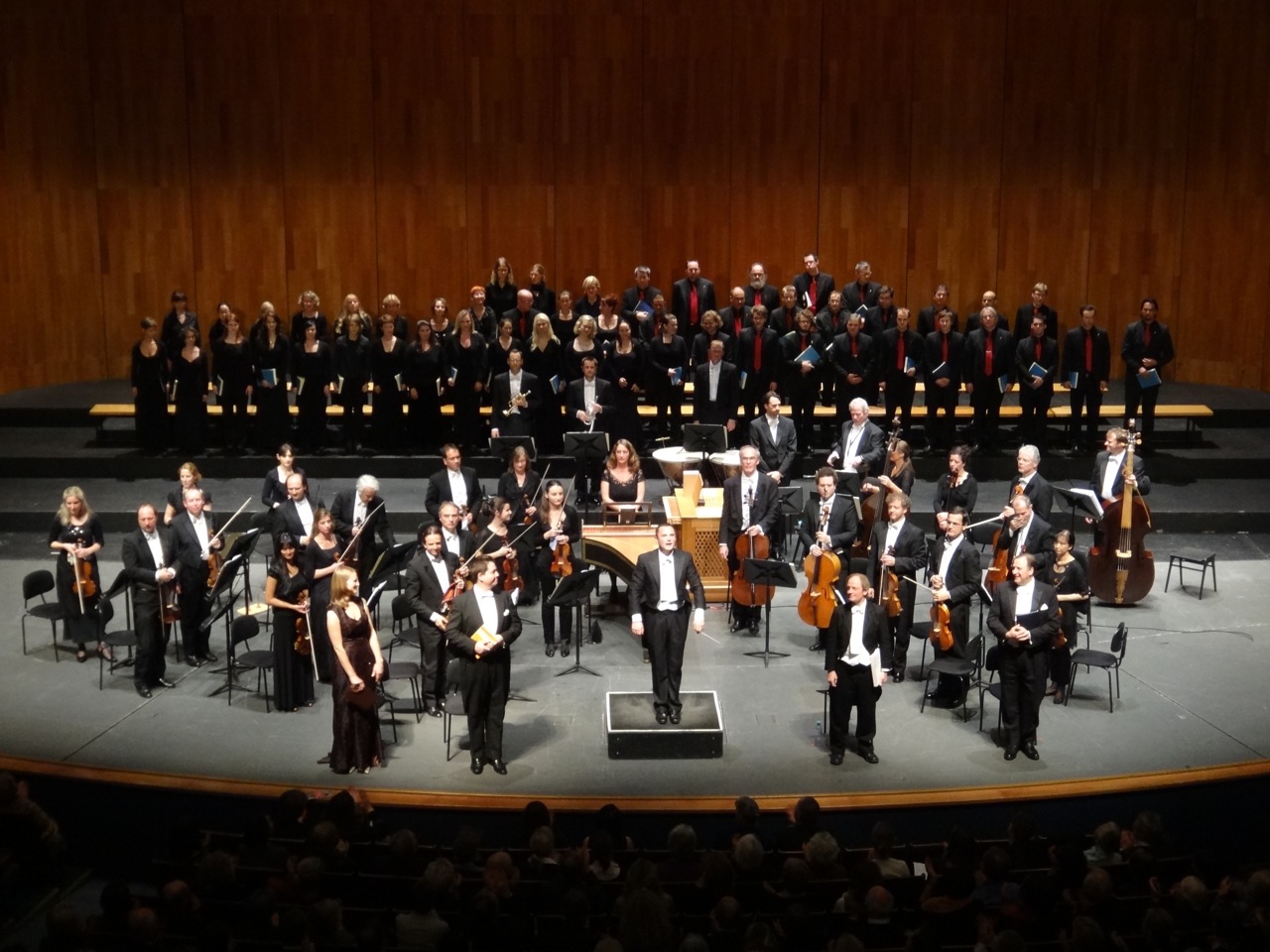

Picture this: a medieval castle rising from the middle of a pristine Alpine lake, connected to shore by a slender wooden bridge. Schloss Ort breaks every rule about Austrian castles. While Habsburg palaces dominated city centers, this enchanting fortress chose solitude on Traunsee Lake’s tiny island. The Salzkammergut region delivers Austria’s most romantic castle story – one that Hollywood couldn’t have scripted better.

History of Schloss Ort

Nine centuries ago, Hartnidus of Ort chose this isolated rock as the perfect spot for his stronghold. Founded around 1080 ↱ (Wikipedia, Schloss Ort), the castle became one of Austria’s earliest fortifications. Medieval politics meant constant ownership changes. The Wallsee brothers – Friedrich and Reinprecht I – bought it in 1344, though Friedrich seized control by 1350.

Royal attention arrived in 1595 when Gmunden’s city fathers sold their prized possession to Emperor Rudolf II. Yet the castle’s most intriguing chapter began in 1876 with Archduke Johann Salvator, who collected five Gmunden estates including this water-bound jewel.

Johann Salvator’s tale reads like a Victorian adventure novel. The Habsburg prince shocked Europe in 1889 by renouncing his royal title, adopting the name Johann Orth, and planning a South American escape. He sailed away in 1890 aboard his ship St. Margaret with his bride, heading for Cape Horn. Neither was ever seen again. Officially declared dead in 1911, Johann’s fate remains one of Austria’s great unsolved mysteries.

Architectural Highlights of Schloss Ort

Two castles tell one story here. The Seeschloss (lake castle) commands its island kingdom while the Landschloss (land castle) anchors the mainland shore. A 123-meter wooden bridge spans the gap, creating perfect symmetry between the structures. This photogenic connection draws the eye from one building to the other.

Fire nearly erased the castle’s history in 1634, destroying most medieval structures. Rebuilding preserved the 17th-century character we admire today. The island fortress showcases late Gothic architecture wrapped around an unusual triangular courtyard. Step inside to discover St. James the Elder chapel, built during the 1634 reconstruction.

Water surrounds every stone wall. Crystal-clear Traunsee reflects the castle’s towers while the Erlakogel mountains create a backdrop worthy of fairy tales. No wonder photographers consider this Austria’s most romantic castle setting.

Visitor Experience at Schloss Ort

Austrian television made Schloss Ort famous worldwide through “Schlosshotel Orth,” which ran from 1996 to 2004. Millions watched fictional guests check into this lakeside retreat, though the real castle never operated as a hotel.

Reality offers something better than fiction. Cross that famous wooden bridge to reach the castle restaurant. Dine surrounded by Traunsee’s pristine waters with Alpine peaks reflected in every direction.

Romance lives here year-round. The castle hosts 362 wedding ceremonies annually – couples can’t resist exchanging vows in such a magical setting. Cultural events, concerts, and readings fill the historic calendar. Gmunden purchased the property in 1995, funding complete restoration that opened every historic room to visitors.

Castle lovers shouldn’t miss this Alpine treasure. Schloss Ort delivers that authentic medieval experience most travelers dream about – a real fortress surrounded by water, where legends come alive and every photograph looks like a postcard.

Schloss Eggenberg, Graz

Schloss Eggenberg, Graz
Schloss Eggenberg in Graz. Hiltibold from Österreich, via Wikimedia Commons

Numbers hold power at Schloss Eggenberg. This isn’t your typical baroque palace – it’s a mathematical marvel built to mirror the cosmos itself. Every window, room, and tower follows an ancient astronomical code that transforms architecture into astrology.

History of Schloss Eggenberg

Few families have climbed higher than the Eggenbergs. Their journey from humble bankers to Holy Roman Empire powerhouses reads like a medieval success story. When Prince Hans Ulrich von Eggenberg reached the peak of his influence in 1625, he wanted a palace that reflected his cosmic ambitions. Court architect Giovanni Pietro de Pomis got the commission to build something extraordinary.

Drawing inspiration from Spain’s legendary El Escorial, the design wrapped around the family’s existing medieval residence. Hans Ulrich never saw his masterpiece completed. After his death in 1634, grandson Johann Seyfried took over the project, commissioning approximately 600 ceiling paintings (↱ Wikipedia: Eggenberg Palace) that took just seven years to finish. The final chapter came in 1754 when Maria Eleonora, the last Eggenberg princess, and her husband Count Herberstein redesigned the main floor in full rococo splendor.

Architectural Highlights of Schloss Eggenberg

Here’s where things get mystical. The palace operates as a giant calendar carved in stone:

  • 365 exterior windows mark each day of the year
  • 31 rooms per floor represent the days in a month
  • 24 state rooms with 52 doors and 60 windows symbolize hours, weeks, and minutes
  • 4 corner towers stand for the seasons

This celestial obsession reaches its peak in the Planetary Room. Court painter Hans Adam Weissenkircher completed this astronomical showcase in 1685, weaving together the four elements, twelve zodiac signs, and the seven planets known to 17th-century science.

Visitor Experience at Schloss Eggenberg

The palace guards its secrets well. Those state rooms with their 500+ ceiling paintings can only be explored through guided tours offered in English and German. Each 50-minute tour takes maximum 25 people, creating an intimate journey through cosmic symbolism.

The palace complex houses multiple attractions beyond the main residence. Archaeological treasures, coin collections, and classical artwork fill separate museums throughout the grounds. Outside, landscaped gardens provide a romantic backdrop where peacocks wander freely, adding their own touch of aristocratic elegance.

Adult admission runs €20 for the state rooms tour, with discounted rates available for seniors, students, and families. This UNESCO World Heritage Site proves that sometimes the most fascinating royal stories hide in plain sight, disguised as mathematical poetry.

Schloss Ambras, Innsbruck

Innsbruck Schloss Ambras
Innsbruck Schloss Ambras – Zairon, via Wikimedia Commons

High above Innsbruck’s rooftops, 632 meters above sea level (↱ Wikipedia: Ambras Castle), sits a Renaissance treasure that breaks the mold of Austrian palace visits. Schloss Ambras isn’t just another royal residence – it’s home to what historians consider the world’s first systematic museum. Here, passion for collecting trumped imperial politics.

History of Schloss Ambras

The name “Amras” or “Omras” surfaces in documents from the 10th century. After the original fortress met its end in 1133, the site lay empty for centuries. Then came Archduke Ferdinand II with grand romantic plans. The 16th-century palace he built wasn’t for state ceremonies – it was a love nest for his secret wife, Philippine Welser. Their family called it home from 1567 to 1595.

Ferdinand’s true obsession, though, was collecting. Everything from armor to oddities caught his eye. What started as personal fascination evolved into the world’s first organized museum. So serious was his commitment that in 1589, he constructed the Heldenrüstkammer building solely to showcase his “Heroes” collection.

Architectural Highlights of Schloss Ambras

Three distinct sections make up this hilltop complex. The Upper Castle housed the family’s private quarters. Below stretches the spectacular Spanish Hall, built between 1569 and 1572 – one of the Renaissance’s finest freestanding halls. Along its 43-meter length hang 27 full-length portraits of Tyrolean rulers, creating a gallery of regional power.

The Inner Courtyard steals the show with its pristine 16th-century frescoes. These grisaille works – gray paintings on wet plaster – bring virtues, muses, and heroic deeds to life across the walls.

Visitor Experience at Schloss Ambras

Ferdinand’s Chamber of Art and Wonders remains exactly where he placed it – the only Renaissance Kunstkammer still in its original location. Natural curiosities sit beside scientific instruments, toys, and luxury items in cases that tell stories of Renaissance wonder. The Armories showcase rare 15th-century weapons, including pieces from Emperor Maximilian I’s personal collection.

Visit any day from 10 AM to 5 PM, except during November’s annual closure. German-language tours run daily, with special children’s tours every Saturday. Audio guides offer additional depth for self-guided exploration.

When museum fatigue sets in, Café & Bistro FERDINAND provides the perfect break, staying open throughout museum hours.

Hohenwerfen Castle, Werfen

Schloss Hohenwerfen, Werfen, Austria
Schloss Hohenwerfen, Werfen, Austria Diego Delso, via Wikimedia Commons

Medieval stone meets Alpine sky at Hohenwerfen Castle, where fortress walls have stood guard over the Salzach valley for nearly a thousand years. Perched on its 155-meter rock pillar like an ancient watchman, this imposing stronghold breaks the mold of Austria’s elegant palace tradition. Here, military might trumped imperial refinement.

History of Hohenwerfen Castle

Archbishop Gebhard’s urgent need for defense sparked Hohenwerfen’s birth in 1077 (↱ burg-hohenwerfen.at). Political chaos and the investiture controversy demanded fortified positions, so he commissioned this fortress alongside Hohensalzburg as twin guardians of the region. What started as simple wooden battlements grew into the substantial stone fortress we recognize today, reaching its current proportions by the 15th century.

Rebellion marked Hohenwerfen’s most turbulent chapter. Angry peasants and miners seized control in 1525, holding the fortress for months before their inevitable defeat left scars across the ancient stones. The centuries that followed saw it serve as a prison, its dungeons echoing with the despair of countless captives through the 17th and 18th centuries. Bavarian occupation brought neglect and decay until Archduke Johann’s restoration efforts between 1824-1833 breathed life back into the crumbling walls. Fate struck cruelly in 1931 when fire consumed much of Archduke Eugene’s rebuilt masterpiece, forcing yet another reconstruction before the Nazi regime claimed it during Austria’s darkest hour.

Architectural Highlights of Hohenwerfen Castle

Nature chose Hohenwerfen’s stage well. At 623 meters above sea level, the castle commands views across the Berchtesgaden Alps and Tennen Mountains, its silhouette visible for miles around. Every stone placement served strategy – this was architecture born of warfare, not luxury.

Visitor Experience at Hohenwerfen Castle

Modern visitors discover weapons that once defended these walls during guided tours that reveal the fortress’s military heritage. The real spectacle comes alive during falconry demonstrations, where eagles, falcons, hawks and vultures soar above the battlements twice daily at 11:15 AM and 3:15 PM, with extra shows during summer months.

Since opening to tourists in 1987, Hohenwerfen has shared darker chapters of regional history, including exhibitions on the Salzburg witch trials that once terrorized local communities. Film enthusiasts might recognize the castle’s dramatic profile from “Where Eagles Dare,” where Hollywood found the perfect medieval backdrop.

Schloss Leopoldskron, Salzburg

Schloss Leopoldskron und Festung Hohensalzburg
Schloss Leopoldskron und Festung Hohensalzburg, Matthias Süßen, via Wikimedia Commons (AI enhanced)

Hollywood came calling at this rococo gem just outside Salzburg’s medieval core. Schloss Leopoldskron earned worldwide fame when “The Sound of Music” cameras captured its elegant facade, though its real story proves far more complex than any musical.

History of Schloss Leopoldskron

Prince-Archbishop Leopold Anton Firmian built this palace in 1736 with mixed motives – partly for prestige, partly to rehabilitate his family name after forcibly exiling over 22,000 Protestants from his territory. The design came from an unlikely source: Bernard Stuart, a Scottish Benedictine monk with zero architectural training but apparently keen aesthetic instincts.

Theater visionary Max Reinhardt rescued the crumbling palace in 1918, pouring two decades of passion and resources into its restoration. His Jewish heritage made him a Nazi target, and they seized his beloved palace in 1939 as “Jewish property”. Redemption arrived in 1947 when Salzburg Global Seminar transformed it into an international dialogue center, a mission it continues today.

Architectural Highlights of Schloss Leopoldskron

Stuart’s amateur architecture produced a near-perfect cube adorned with intricate facade details. The interior showcases Johann Kleber’s masterful rococo stuccowork – experts consider it “the best example of rococo stucco the land can offer”. The soaring Marble Hall doubles as banquet space and concert venue, while the grand staircase features warm marble from nearby Untersberg mountain.

Visitor Experience at Schloss Leopoldskron

This palace trades tourist crowds for hotel guests. The main building houses 12 elegant suites, while the adjacent Meierhof offers 55 additional rooms. Sound of Music enthusiasts will recognize those famous exterior shots, though the interiors were filmed elsewhere. Since it operates as a luxury hotel rather than public attraction, your best viewing angle comes from across Leopoldskroner Weiher pond – where many visitors snap that perfect postcard photo.

Conclusion

Nine palaces, nine stories, one empire that once stretched across half of Europe. Each castle and palace we’ve explored reveals a different facet of Austria’s imperial soul – from Schönbrunn’s 1,441 rooms of baroque grandeur to Schloss Ort’s fairy-tale silhouette floating on Traunsee Lake.

These aren’t museum pieces frozen in time. Mozart’s melodies still seem to drift through Schönbrunn’s corridors. Napoleon’s presence lingers in the Hofburg’s imperial chambers. Haydn’s compositions echo eternally in the acoustically perfect Haydnsaal at Schloss Esterházy. Every gilded ceiling fresco, every marble hall, every secret passage holds memories of the men and women who once ruled from Vienna to Budapest, from Prague to Milan.

Timing your palace pilgrimage matters. Autumn delivers ideal weather for indoor explorations without summer’s crowds crushing your contemplative moments. Winter brings Christmas markets that transform palace courtyards into twinkling wonderlands – Schönbrunn becomes particularly magical. Spring and summer reveal the gardens in their full glory, especially Belvedere’s baroque landscaping and Schönbrunn’s geometric perfection.

Families find plenty to captivate young imaginations – interactive exhibits at Schönbrunn’s Children’s Museum, soaring birds of prey at Hohenwerfen’s falconry shows. Art devotees can lose themselves before Klimt’s “The Kiss” at Belvedere, while music enthusiasts discover where Europe’s greatest composers once walked and worked.

Smart planning enhances your experience significantly. Online booking saves precious time, especially during peak tourist seasons. English-language tours operate at most locations, though schedules vary seasonally. Budget several hours per major palace complex – rushing through centuries of history serves no one well.

The Habsburg dynasty may have ended in 1918, yet their architectural legacy endures as Austria’s greatest treasure. These palaces stand as monuments to an age when art, music, and power converged in ways we’ll never see again. Step inside any of these nine royal residences, and you’ll understand why Austria remains one of Europe’s most culturally rich destinations – a place where imperial dreams still echo in every ornate room.

FAQs

Q1. Which palace in Vienna is considered a must-visit?
Schönbrunn Palace is widely regarded as the top palace to visit in Vienna. Its stunning architecture, rich history, and beautiful gardens make it an essential stop for anyone exploring Austria’s imperial heritage.

Q2. What is Austria’s most renowned palace?
Schönbrunn Palace is Austria’s most famous palace. Originally intended as a hunting lodge, it became the summer residence of the Habsburg rulers and is now a UNESCO World Heritage site, attracting millions of visitors annually.

Q3. How do Schönbrunn and Hofburg Palaces compare?
Both palaces offer unique experiences. Schönbrunn is known for its grand gardens and family-friendly attractions, while Hofburg focuses more on imperial history and houses the Imperial Treasury. Visiting both provides a comprehensive view of Vienna’s royal past.

Q4. Which Austrian castle is considered the most picturesque?
While beauty is subjective, Schloss Ort in Gmunden is often cited as one of Austria’s most beautiful castles. Its fairytale-like appearance, situated on a tiny island in Traunsee Lake, creates a truly magical setting.

Q5. Are there any palaces in Austria where visitors can stay overnight?
Yes, Schloss Leopoldskron in Salzburg offers this unique experience. Famous as a filming location for “The Sound of Music,” it now functions as a hotel where guests can stay in the palace itself or in rooms in the adjacent Meierhof building.

Links:

Schönbrunn Palace, Vienna
Tourist Info Vienna
Vienna Sightseeing Tours
Sisi Museum, Hofburg
Belvedere Palace, Vienna
Schloss Esterházy, Eisenstadt
Universalmuseum Joanneum
Schloss Ambras, Innsbruck
Burg Hohenwerfen

Scroll to top